

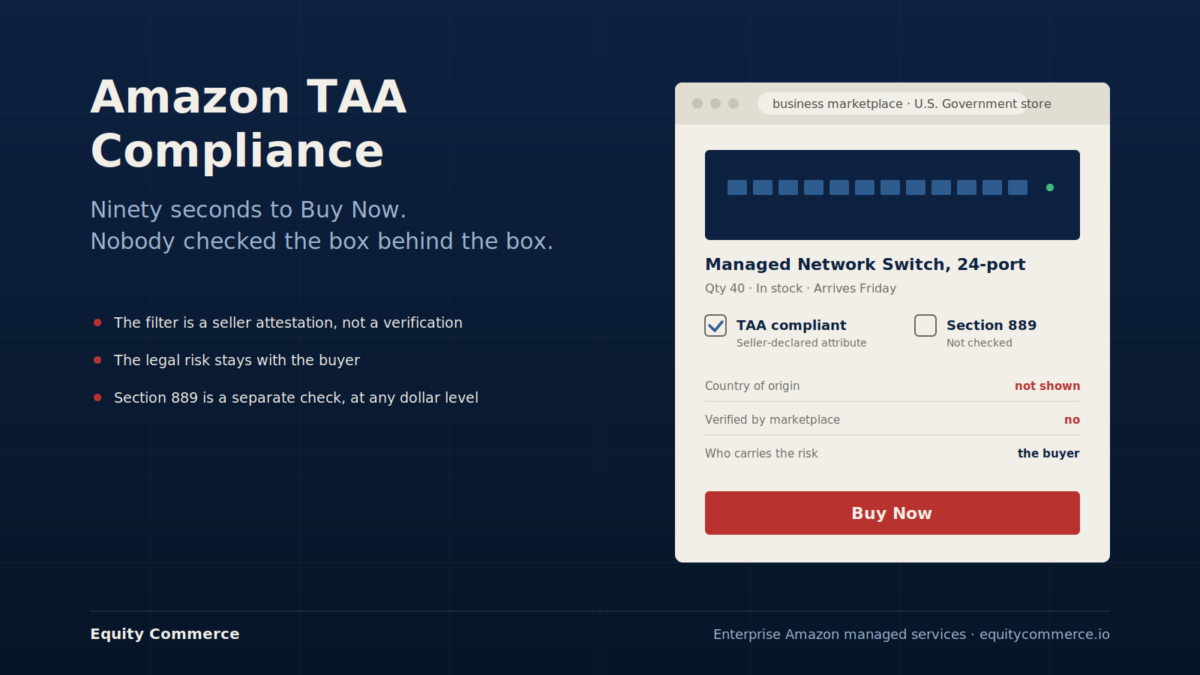
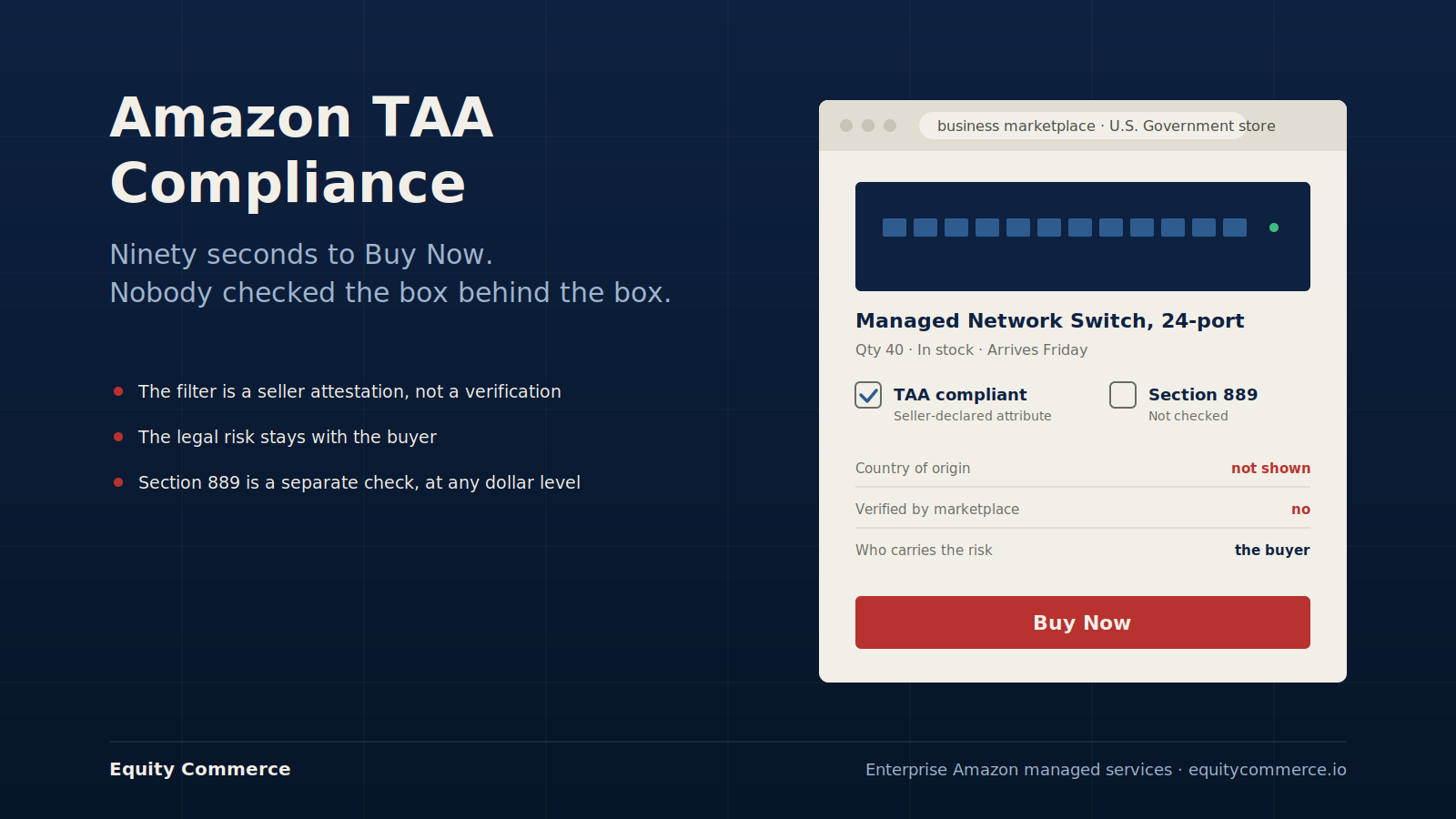
A program manager at a county water authority needs forty network switches by Friday. She opens her government Amazon Business account, filters for what’s in stock, and clicks Buy Now. The whole thing takes about ninety seconds. What she may not realize is that whether those switches are Amazon TAA compliant can decide whether her agency just made a legal purchase or an illegal one, and the catalog let her buy either way.
Short answer: Amazon Business does sell TAA-compliant products, and its U.S. Government storefront lets you filter for them using seller attestations under the Trade Agreements Act. But an “Amazon TAA compliant” label is not something Amazon independently verifies. It is a box a third-party seller checked, and the legal risk for getting it wrong stays with the buyer. The rest of this guide covers what TAA compliance means, how to find TAA-compliant products on Amazon, which countries qualify in 2026, what it takes to sell compliant goods, and where the storefront’s filter quietly stops protecting you.
What “TAA Compliant” Actually Means
The Trade Agreements Act of 1979, codified at 19 U.S.C. 2501 and following, exists to implement a stack of international trade agreements the United States has signed, chief among them the World Trade Organization’s Government Procurement Agreement. The practical effect is simpler than the statute. Above a certain dollar threshold, the federal government may only buy products that come from the United States or from a “designated country,” meaning a country that has agreed to open its own government markets to U.S. goods in return.
A product earns TAA-compliant status one of two ways. It is wholly grown or manufactured in the United States or a designated country, or it was “substantially transformed” in such a country into a new article with a different name, character, or use. A circuit board fabricated in Taiwan and then built into a finished server in Mexico can qualify, because the final assembly substantially transformed the components into something distinct. Where that transformation happened is the country of origin for TAA purposes.
Two wrinkles catch sellers off guard. When origin is genuinely contested, the binding answer often comes from U.S. Customs and Border Protection, which issues final determinations on where a product was substantially transformed. CBP has weighed in on hard cases like cloud-based software, where the line between real transformation and mere assembly gets slippery fast. The second wrinkle is that the rule works differently for services. A service’s country of origin turns on where the company performing it is established, meaning where it is incorporated or headquartered, so a U.S.-domiciled firm can use workers abroad and still qualify.
Here is the point that causes the most confusion. Plenty of sellers, and some contracting staff, believe TAA compliance turns on whether more than half the manufacturing cost originates in qualifying countries. It does not. That fifty-percent-of-cost logic belongs to the Buy American Act, a separate statute with its own domestic-content math. TAA uses the substantial transformation test, which is about the nature of the manufacturing step, not a tally of component costs. Mixing the two leads people to certify products with the wrong yardstick entirely, which is exactly the error that surfaces during an audit.
The dollar threshold matters because the rule only switches on above it. As of 2026 the WTO GPA threshold for most supply and service contracts sits around $183,000, and it gets revised on a roughly two-year cycle, so the precise figure drifts (recent sources have cited numbers from $174,000 to $183,000). Some free-trade-agreement partners trigger at lower amounts. Below the threshold, TAA does not formally apply, and the more familiar Buy American preferences take over. That threshold is the loophole, the safety valve, and the reason most marketplace buying escapes the heaviest scrutiny. Hold that thought.
TAA-Compliant Countries in 2026 (and the Ones That Don’t Count)
The designated-country list runs to roughly 120 nations. It includes most of Western Europe, Canada, Japan, South Korea, Taiwan, Australia, and dozens of smaller economies. The list matters most for who is missing. China is not a designated country. Neither is India, Russia, Indonesia, Malaysia, Brazil, or Thailand. So a hard drive assembled in Shenzhen, a desk lamp molded in Malaysia, or a uniform sewn in India generally fails the TAA test on its face, no matter how good the price or how fast the shipping.
This is why country of origin, not brand, is the thing to read on a listing. A keyboard “Made in Taiwan” can be compliant because Taiwan is designated. The same model from a Chinese line is not. The official designated-country list lives in the Federal Acquisition Regulation and on GSA’s vendor resources, and it is worth checking against rather than guessing, because the membership shifts as trade agreements change.
How to Find TAA-Compliant Products on Amazon
Amazon Business runs a U.S. Government storefront aimed at federal, state, local, and education buyers. This is where most of the compliance machinery an ordinary card-holder will touch actually lives. The storefront lets you filter for products carrying seller attestations under both the Buy American Act and the Trade Agreements Act. It also surfaces Section 889 certified sellers, AbilityOne products, and goods from small and veteran-owned businesses.
For centralized federal accounts, Amazon maintains a deliberately limited pool of TAA-eligible items and asks agencies to email a dedicated address, AB-TAA@amazon.com, to request access. The company is candid that this pool is small, citing higher manufacturing costs and thinner supply chains for compliant goods, and that most of those TAA items have nearly identical non-compliant twins available to everyone else on the site.
Concrete examples make the pattern clear. Logitech sells a “TAA-compliant version” of its Rally Bar video conferencing kit specifically for government rooms. Adesso and Kensington list smart-card-reader keyboards labeled TAA compliant and Made in Taiwan, marketed for federal and military buyers. Buffalo Americas flags networking gear made in Japan as TAA compliant. Allied Telesis sells PCIe fiber adapters with the TAA badge. The common thread is not the brand. It is a stated country of origin that is the United States or a designated country, paired with a seller willing to attest to it.
The honest way to read all of this: the storefront filter and the curated catalog are useful starting points, and for routine sub-threshold buying they are probably adequate. They are not a substitute for confirming country of origin on anything sensitive or high-volume.
Is the “Amazon TAA Compliant” Label Trustworthy?
Here is where I’ll take a position. Amazon does not manufacture most of what it sells. The U.S. Government storefront, like the rest of the marketplace, leans heavily on third-party sellers, who now account for roughly two-thirds of units sold across Amazon overall. Country-of-origin information on a listing comes from the seller, by self-attestation. The seller checks the box. Amazon displays the result. Amazon is not auditing, factory by factory, where each item was substantially transformed.
You can see why the model is built this way. Amazon’s catalog runs to hundreds of millions of items, and independently verifying the provenance of each against the substantial transformation test would be slow and probably impossible at that scale. Self-attestation is the only mechanism that fits the volume. It is also the mechanism that quietly relocates the legal risk.
Think through who is exposed when an attestation is wrong. The seller made a representation, but the agency that bought the item, and any prime contractor reselling to the government, carries the federal compliance obligation. If a contractor certifies that goods are TAA compliant and they are not, the consequences are not theoretical. Contracts get terminated. Civil penalties follow. Misrepresenting country of origin on a government sale draws False Claims Act liability, where damages can be trebled and whistleblowers share in the recovery. People and companies are prosecuted for this every year. The seller’s tidy checkbox does not move that exposure off the buyer. It just makes the buyer feel covered.
So the filter does something subtle. It produces the appearance of diligence. A card-holder who filters for TAA compliant and buys only from that set has a story to tell during an audit, and that story is genuinely better than buying blind. But the filter is only as honest as the thousands of attestations feeding it, and Amazon’s marketplace enforcement, increasingly automated, is built to catch counterfeits and policy violations at speed rather than to verify manufacturing geography with a customs lawyer’s care. Amazon has said it invested more than a billion dollars in 2024 in fraud and counterfeit detection. That is real money pointed at a real problem. It is not the same problem as TAA provenance.
My read, and reasonable people in procurement disagree, is that the “Amazon TAA compliant” badge is a useful tool being asked to carry more weight than it can bear. It reduces risk. It does not erase it. Treating a green badge as the end of due diligence rather than the start of it is how an agency ends up explaining to an inspector general why it has four hundred non-compliant tablets in a supply closet.
Section 889: The Compliance Check Right Next to TAA
Buyers constantly mistake this rule for the same thing, and the confusion is dangerous because the two operate independently. Section 889 of the FY2019 NDAA bans the government from buying or using covered telecommunications and video surveillance equipment from a specific set of Chinese companies: Huawei, ZTE, Hytera, Hikvision, and Dahua, along with their subsidiaries and affiliates. The sale prohibition took effect in August 2019 and the broader use prohibition in August 2020.
A product can clear one rule and fail the other. A security camera substantially transformed in a designated country might satisfy TAA while still being a Hikvision unit, which Section 889 prohibits outright. Buying compliant means clearing both checks, which is why Amazon’s storefront flags Section 889 certification separately from the TAA filter. A buyer who looks at only one badge has done half the work and may not know it.
How Amazon Business Ended Up Selling to the Government
Amazon did not wander into federal procurement. It was invited, more or less, by Congress. Section 846 of the National Defense Authorization Act for Fiscal Year 2018 directed the General Services Administration to set up a way for agencies to buy commercial products through online marketplaces. GSA called it the Commercial Platforms program and launched a proof of concept in June 2020, awarding contracts to three providers: Amazon Business, Overstock’s government arm, and Fisher Scientific.
The program has one defining limit. Purchases run only up to the micro-purchase threshold, generally $10,000 per transaction. That ceiling is not an accident. It keeps the bulk of marketplace buying below the level where TAA formally applies. The Government Accountability Office has flagged concerns along the way, less about country of origin and more about data, since Section 838 of the FY2019 NDAA bars platform providers from using supplier transaction data for their own competitive purposes, and GAO questioned whether GSA’s monitoring was strong enough to catch a violation.
Buying and Selling TAA-Compliant Products on Amazon: Practical Steps
For an agency buyer, the most important fact is the one that feels least intuitive: the micro-purchase threshold is doing a lot of the protecting. Most marketplace orders fall below the $10,000 line. That does not make country of origin irrelevant, because agency policy, Buy American preferences, and Section 889 can all still bite below the threshold, but it concentrates the heaviest TAA exposure in larger or aggregated buys. If a single requisition or a standing order pushes a category above the threshold, the easy marketplace habits stop being safe. Keep a record of why each purchase was treated as compliant. Verify country of origin independently for anything sensitive or high-volume. Resist treating the storefront filter as a legal opinion. It is evidence of reasonable care, nothing more.
For a seller chasing government business on Amazon, the attestation is the product. Get it wrong and the downside is not a bad review, it is potential fraud liability and removal from the storefront. Run the substantial transformation analysis instead of guessing. Keep country-of-origin documentation and supplier certificates current and retrievable. Revisit the analysis whenever a manufacturer shifts production, which happens more often than most sellers track. GSA explicitly warns Schedule contractors to recheck country of origin periodically because factories move. A product that was compliant when listed can quietly stop being compliant when the manufacturer opens a line in a non-designated country, and nobody updates the listing.
The harder strategic question for sellers is whether the compliant catalog is worth supplying at all. Amazon’s own framing tells you something: the TAA pool is small, the items cost more, and cheaper non-compliant equivalents sit right beside them. A seller who invests in genuinely compliant sourcing competes, on a price-sorted marketplace, against the identical-looking non-compliant version. The design rewards the very thing the compliance regime tries to prevent, and that is not a flaw Amazon can easily fix, because it is baked into what a consumer-style catalog is for.
The Mismatch Nobody Has Solved
Step back and the friction is structural. A marketplace optimized for selection, price, and speed is being asked to enforce a sourcing regime that turns on slow, document-heavy questions about where a product was transformed and which treaties its country has signed. Amazon has done a reasonable amount to paper over the gap, with attestation filters, a curated government storefront, dedicated TAA support, and Section 889 flagging. Those tools beat nothing, and for routine sub-threshold buying they are probably enough.
What they cannot do is make a self-attestation as reliable as an independent customs determination, and they cannot change the economics that put the compliant item at a price disadvantage on the same screen as its non-compliant twin. GSA built the Commercial Platforms program with a micro-purchase ceiling precisely because letting marketplace dynamics loose on large, TAA-governed buys was a risk it was not ready to take. That ceiling is an admission that the model has limits.
So the open question is not whether Amazon Business can sell TAA-compliant products to the government. It plainly can, and the volume keeps growing. The question is whether self-attestation at marketplace scale is a durable foundation for compliance, or a convenient arrangement that holds right up until a high-profile audit finds a wall of non-compliant gear bought through a storefront everyone trusted. GAO has been circling the program’s oversight gaps for years without forcing a reckoning. The contracting officers I would trust on this are not the ones who feel reassured by the filter. They are the ones who use it and still check.
Frequently Asked Questions
Is Amazon TAA compliant? Amazon itself is not “compliant” or “non-compliant,” because compliance is a property of individual products, not of the marketplace. Amazon Business does sell TAA-compliant products and offers a U.S. Government storefront with a TAA filter, but whether any given item qualifies depends on the seller’s country-of-origin attestation, which Amazon does not independently verify.
How do I find TAA-compliant products on Amazon? Use the Amazon Business U.S. Government storefront and filter by the Trade Agreements Act attestation. Read the listed country of origin on the product detail page, and look for items explicitly labeled as TAA compliant by brands like Logitech, Adesso, Kensington, Buffalo, and Allied Telesis. Centralized federal accounts can request access to a curated TAA pool by emailing AB-TAA@amazon.com.
What countries are TAA compliant in 2026? Roughly 120 designated countries qualify, including the United States, Canada, Japan, South Korea, Taiwan, Australia, and most of Western Europe. China, India, Russia, Malaysia, Indonesia, Brazil, and Thailand are not designated, so products made there generally are not TAA compliant unless they were substantially transformed in a qualifying country.
Does the micro-purchase threshold mean TAA doesn’t apply on Amazon? TAA formally applies above the WTO GPA threshold (around $183,000 in 2026), and most marketplace orders fall below the $10,000 micro-purchase threshold. But agency policy, Buy American preferences, and Section 889 can still apply to small buys, so country of origin still matters even when TAA does not technically trigger.
Can I trust Amazon’s TAA filter for a federal contract? Treat it as a useful screen, not a guarantee. The filter reflects seller self-attestations, and the legal liability for a wrong attestation, including False Claims Act exposure, falls on the buyer and any prime contractor, not on Amazon. Verify country of origin independently for anything high-value or sensitive.
Sources and Further Reading
- FAR 52.225-5, Trade Agreements (acquisition.gov)
- GSA Vendor Support Center: Trade Agreements Act (TAA) Compliance
- GSA designated-countries list
- Amazon Business Help: Trade Agreement Act (TAA) for product purchase
- NDAA FY2018 Section 846 (Commercial Platforms program) and FY2019 Section 889