
Categories
E-Commerce

Amazon TAA Compliance: How to Find and Sell TAA-Compliant Products

Amazon TAA Compliance: How to Find and Sell TAA-Compliant Products

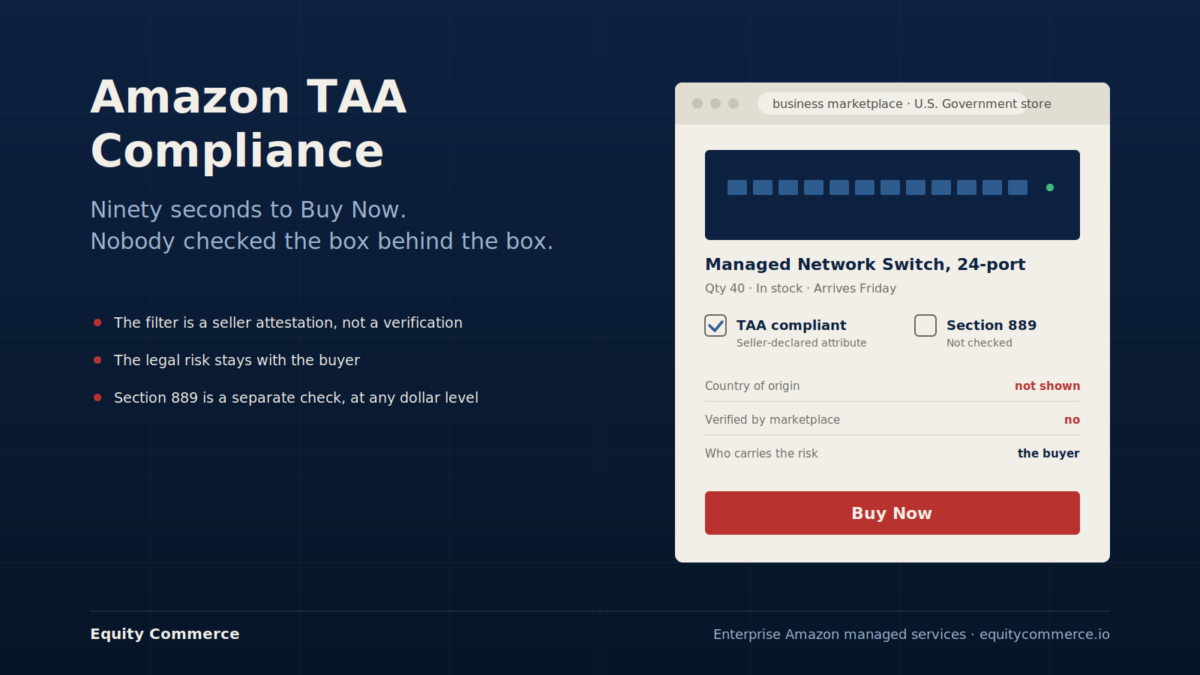
A program manager at a county water authority needs forty network switches by Friday. She opens her government Amazon Business account, filters for what’s in stock, and clicks Buy Now. The whole thing takes about ninety seconds. What she may not realize is that whether those switches are Amazon TAA compliant can decide whether her agency just made a legal purchase or an illegal one, and the catalog let her buy either way.

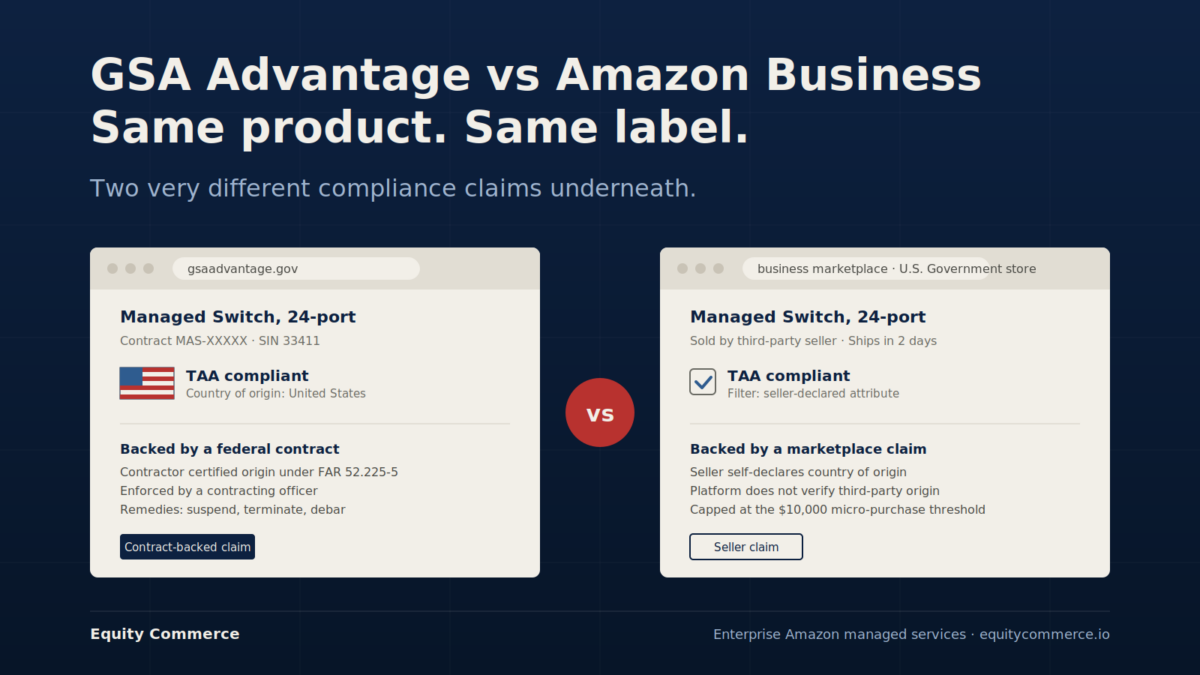
Short answer: Amazon Business does sell TAA-compliant products, and its U.S. Government storefront lets you filter for them using seller attestations under the Trade Agreements Act. But an “Amazon TAA compliant” label is not something Amazon independently verifies. It is a box a third-party seller checked, and the legal risk for getting it wrong stays with the buyer. The rest of this guide covers what TAA compliance means, how to find TAA-compliant products on Amazon, which countries qualify in 2026, what it takes to sell compliant goods, and where the storefront’s filter quietly stops protecting you.

What “TAA Compliant” Actually Means

The Trade Agreements Act of 1979, codified at 19 U.S.C. 2501 and following, exists to implement a stack of international trade agreements the United States has signed, chief among them the World Trade Organization’s Government Procurement Agreement. The practical effect is simpler than the statute. Above a certain dollar threshold, the federal government may only buy products that come from the United States or from a “designated country,” meaning a country that has agreed to open its own government markets to U.S. goods in return.

A product earns TAA-compliant status one of two ways. It is wholly grown or manufactured in the United States or a designated country, or it was “substantially transformed” in such a country into a new article with a different name, character, or use. A circuit board fabricated in Taiwan and then built into a finished server in Mexico can qualify, because the final assembly substantially transformed the components into something distinct. Where that transformation happened is the country of origin for TAA purposes.

Two wrinkles catch sellers off guard. When origin is genuinely contested, the binding answer often comes from U.S. Customs and Border Protection, which issues final determinations on where a product was substantially transformed. CBP has weighed in on hard cases like cloud-based software, where the line between real transformation and mere assembly gets slippery fast. The second wrinkle is that the rule works differently for services. A service’s country of origin turns on where the company performing it is established, meaning where it is incorporated or headquartered, so a U.S.-domiciled firm can use workers abroad and still qualify.

Here is the point that causes the most confusion. Plenty of sellers, and some contracting staff, believe TAA compliance turns on whether more than half the manufacturing cost originates in qualifying countries. It does not. That fifty-percent-of-cost logic belongs to the Buy American Act, a separate statute with its own domestic-content math. TAA uses the substantial transformation test, which is about the nature of the manufacturing step, not a tally of component costs. Mixing the two leads people to certify products with the wrong yardstick entirely, which is exactly the error that surfaces during an audit.

The dollar threshold matters because the rule only switches on above it. As of 2026 the WTO GPA threshold for most supply and service contracts sits around $183,000, and it gets revised on a roughly two-year cycle, so the precise figure drifts (recent sources have cited numbers from $174,000 to $183,000). Some free-trade-agreement partners trigger at lower amounts. Below the threshold, TAA does not formally apply, and the more familiar Buy American preferences take over. That threshold is the loophole, the safety valve, and the reason most marketplace buying escapes the heaviest scrutiny. Hold that thought.

TAA-Compliant Countries in 2026 (and the Ones That Don’t Count)

The designated-country list runs to roughly 120 nations. It includes most of Western Europe, Canada, Japan, South Korea, Taiwan, Australia, and dozens of smaller economies. The list matters most for who is missing. China is not a designated country. Neither is India, Russia, Indonesia, Malaysia, Brazil, or Thailand. So a hard drive assembled in Shenzhen, a desk lamp molded in Malaysia, or a uniform sewn in India generally fails the TAA test on its face, no matter how good the price or how fast the shipping.

This is why country of origin, not brand, is the thing to read on a listing. A keyboard “Made in Taiwan” can be compliant because Taiwan is designated. The same model from a Chinese line is not. The official designated-country list lives in the Federal Acquisition Regulation and on GSA’s vendor resources, and it is worth checking against rather than guessing, because the membership shifts as trade agreements change.

How to Find TAA-Compliant Products on Amazon

Amazon Business runs a U.S. Government storefront aimed at federal, state, local, and education buyers. This is where most of the compliance machinery an ordinary card-holder will touch actually lives. The storefront lets you filter for products carrying seller attestations under both the Buy American Act and the Trade Agreements Act. It also surfaces Section 889 certified sellers, AbilityOne products, and goods from small and veteran-owned businesses.

For centralized federal accounts, Amazon maintains a deliberately limited pool of TAA-eligible items and asks agencies to email a dedicated address, AB-TAA@amazon.com, to request access. The company is candid that this pool is small, citing higher manufacturing costs and thinner supply chains for compliant goods, and that most of those TAA items have nearly identical non-compliant twins available to everyone else on the site.

Concrete examples make the pattern clear. Logitech sells a “TAA-compliant version” of its Rally Bar video conferencing kit specifically for government rooms. Adesso and Kensington list smart-card-reader keyboards labeled TAA compliant and Made in Taiwan, marketed for federal and military buyers. Buffalo Americas flags networking gear made in Japan as TAA compliant. Allied Telesis sells PCIe fiber adapters with the TAA badge. The common thread is not the brand. It is a stated country of origin that is the United States or a designated country, paired with a seller willing to attest to it.

The honest way to read all of this: the storefront filter and the curated catalog are useful starting points, and for routine sub-threshold buying they are probably adequate. They are not a substitute for confirming country of origin on anything sensitive or high-volume.

Is the “Amazon TAA Compliant” Label Trustworthy?

Here is where I’ll take a position. Amazon does not manufacture most of what it sells. The U.S. Government storefront, like the rest of the marketplace, leans heavily on third-party sellers, who now account for roughly two-thirds of units sold across Amazon overall. Country-of-origin information on a listing comes from the seller, by self-attestation. The seller checks the box. Amazon displays the result. Amazon is not auditing, factory by factory, where each item was substantially transformed.

You can see why the model is built this way. Amazon’s catalog runs to hundreds of millions of items, and independently verifying the provenance of each against the substantial transformation test would be slow and probably impossible at that scale. Self-attestation is the only mechanism that fits the volume. It is also the mechanism that quietly relocates the legal risk.

Think through who is exposed when an attestation is wrong. The seller made a representation, but the agency that bought the item, and any prime contractor reselling to the government, carries the federal compliance obligation. If a contractor certifies that goods are TAA compliant and they are not, the consequences are not theoretical. Contracts get terminated. Civil penalties follow. Misrepresenting country of origin on a government sale draws False Claims Act liability, where damages can be trebled and whistleblowers share in the recovery. People and companies are prosecuted for this every year. The seller’s tidy checkbox does not move that exposure off the buyer. It just makes the buyer feel covered.

So the filter does something subtle. It produces the appearance of diligence. A card-holder who filters for TAA compliant and buys only from that set has a story to tell during an audit, and that story is genuinely better than buying blind. But the filter is only as honest as the thousands of attestations feeding it, and Amazon’s marketplace enforcement, increasingly automated, is built to catch counterfeits and policy violations at speed rather than to verify manufacturing geography with a customs lawyer’s care. Amazon has said it invested more than a billion dollars in 2024 in fraud and counterfeit detection. That is real money pointed at a real problem. It is not the same problem as TAA provenance.

My read, and reasonable people in procurement disagree, is that the “Amazon TAA compliant” badge is a useful tool being asked to carry more weight than it can bear. It reduces risk. It does not erase it. Treating a green badge as the end of due diligence rather than the start of it is how an agency ends up explaining to an inspector general why it has four hundred non-compliant tablets in a supply closet.

Section 889: The Compliance Check Right Next to TAA

Buyers constantly mistake this rule for the same thing, and the confusion is dangerous because the two operate independently. Section 889 of the FY2019 NDAA bans the government from buying or using covered telecommunications and video surveillance equipment from a specific set of Chinese companies: Huawei, ZTE, Hytera, Hikvision, and Dahua, along with their subsidiaries and affiliates. The sale prohibition took effect in August 2019 and the broader use prohibition in August 2020.

A product can clear one rule and fail the other. A security camera substantially transformed in a designated country might satisfy TAA while still being a Hikvision unit, which Section 889 prohibits outright. Buying compliant means clearing both checks, which is why Amazon’s storefront flags Section 889 certification separately from the TAA filter. A buyer who looks at only one badge has done half the work and may not know it.

How Amazon Business Ended Up Selling to the Government

Amazon did not wander into federal procurement. It was invited, more or less, by Congress. Section 846 of the National Defense Authorization Act for Fiscal Year 2018 directed the General Services Administration to set up a way for agencies to buy commercial products through online marketplaces. GSA called it the Commercial Platforms program and launched a proof of concept in June 2020, awarding contracts to three providers: Amazon Business, Overstock’s government arm, and Fisher Scientific.

The program has one defining limit. Purchases run only up to the micro-purchase threshold, generally $10,000 per transaction. That ceiling is not an accident. It keeps the bulk of marketplace buying below the level where TAA formally applies. The Government Accountability Office has flagged concerns along the way, less about country of origin and more about data, since Section 838 of the FY2019 NDAA bars platform providers from using supplier transaction data for their own competitive purposes, and GAO questioned whether GSA’s monitoring was strong enough to catch a violation.

Buying and Selling TAA-Compliant Products on Amazon: Practical Steps

For an agency buyer, the most important fact is the one that feels least intuitive: the micro-purchase threshold is doing a lot of the protecting. Most marketplace orders fall below the $10,000 line. That does not make country of origin irrelevant, because agency policy, Buy American preferences, and Section 889 can all still bite below the threshold, but it concentrates the heaviest TAA exposure in larger or aggregated buys. If a single requisition or a standing order pushes a category above the threshold, the easy marketplace habits stop being safe. Keep a record of why each purchase was treated as compliant. Verify country of origin independently for anything sensitive or high-volume. Resist treating the storefront filter as a legal opinion. It is evidence of reasonable care, nothing more.

For a seller chasing government business on Amazon, the attestation is the product. Get it wrong and the downside is not a bad review, it is potential fraud liability and removal from the storefront. Run the substantial transformation analysis instead of guessing. Keep country-of-origin documentation and supplier certificates current and retrievable. Revisit the analysis whenever a manufacturer shifts production, which happens more often than most sellers track. GSA explicitly warns Schedule contractors to recheck country of origin periodically because factories move. A product that was compliant when listed can quietly stop being compliant when the manufacturer opens a line in a non-designated country, and nobody updates the listing.

The harder strategic question for sellers is whether the compliant catalog is worth supplying at all. Amazon’s own framing tells you something: the TAA pool is small, the items cost more, and cheaper non-compliant equivalents sit right beside them. A seller who invests in genuinely compliant sourcing competes, on a price-sorted marketplace, against the identical-looking non-compliant version. The design rewards the very thing the compliance regime tries to prevent, and that is not a flaw Amazon can easily fix, because it is baked into what a consumer-style catalog is for.

The Mismatch Nobody Has Solved

Step back and the friction is structural. A marketplace optimized for selection, price, and speed is being asked to enforce a sourcing regime that turns on slow, document-heavy questions about where a product was transformed and which treaties its country has signed. Amazon has done a reasonable amount to paper over the gap, with attestation filters, a curated government storefront, dedicated TAA support, and Section 889 flagging. Those tools beat nothing, and for routine sub-threshold buying they are probably enough.

What they cannot do is make a self-attestation as reliable as an independent customs determination, and they cannot change the economics that put the compliant item at a price disadvantage on the same screen as its non-compliant twin. GSA built the Commercial Platforms program with a micro-purchase ceiling precisely because letting marketplace dynamics loose on large, TAA-governed buys was a risk it was not ready to take. That ceiling is an admission that the model has limits.

So the open question is not whether Amazon Business can sell TAA-compliant products to the government. It plainly can, and the volume keeps growing. The question is whether self-attestation at marketplace scale is a durable foundation for compliance, or a convenient arrangement that holds right up until a high-profile audit finds a wall of non-compliant gear bought through a storefront everyone trusted. GAO has been circling the program’s oversight gaps for years without forcing a reckoning. The contracting officers I would trust on this are not the ones who feel reassured by the filter. They are the ones who use it and still check.

Frequently Asked Questions

Is Amazon TAA compliant? Amazon itself is not “compliant” or “non-compliant,” because compliance is a property of individual products, not of the marketplace. Amazon Business does sell TAA-compliant products and offers a U.S. Government storefront with a TAA filter, but whether any given item qualifies depends on the seller’s country-of-origin attestation, which Amazon does not independently verify.

How do I find TAA-compliant products on Amazon? Use the Amazon Business U.S. Government storefront and filter by the Trade Agreements Act attestation. Read the listed country of origin on the product detail page, and look for items explicitly labeled as TAA compliant by brands like Logitech, Adesso, Kensington, Buffalo, and Allied Telesis. Centralized federal accounts can request access to a curated TAA pool by emailing AB-TAA@amazon.com.

What countries are TAA compliant in 2026? Roughly 120 designated countries qualify, including the United States, Canada, Japan, South Korea, Taiwan, Australia, and most of Western Europe. China, India, Russia, Malaysia, Indonesia, Brazil, and Thailand are not designated, so products made there generally are not TAA compliant unless they were substantially transformed in a qualifying country.

Does the micro-purchase threshold mean TAA doesn’t apply on Amazon? TAA formally applies above the WTO GPA threshold (around $183,000 in 2026), and most marketplace orders fall below the $10,000 micro-purchase threshold. But agency policy, Buy American preferences, and Section 889 can still apply to small buys, so country of origin still matters even when TAA does not technically trigger.

Can I trust Amazon’s TAA filter for a federal contract? Treat it as a useful screen, not a guarantee. The filter reflects seller self-attestations, and the legal liability for a wrong attestation, including False Claims Act exposure, falls on the buyer and any prime contractor, not on Amazon. Verify country of origin independently for anything high-value or sensitive.

Sources and Further Reading

  • FAR 52.225-5, Trade Agreements (acquisition.gov)
  • GSA Vendor Support Center: Trade Agreements Act (TAA) Compliance
  • GSA designated-countries list
  • Amazon Business Help: Trade Agreement Act (TAA) for product purchase
  • NDAA FY2018 Section 846 (Commercial Platforms program) and FY2019 Section 889
Categories
E-Commerce

Amazon Business for Brands in 2026: Why It Matters

Why Amazon Business Belongs in Your 2026 Brand Plan

Most brand teams still file Amazon Business somewhere between “we should look into that” and “isn’t that just the same as selling on Amazon?” Both responses will cost money in 2026. The B2B side of Amazon has grown into a channel with its own buyers, its own pricing logic, and now its own AI tooling, and the brands treating it as a side door are leaving real revenue on the table.

Here is the case for taking it seriously this year, and the specific things worth doing about it.

What Amazon Business actually is now

Amazon Business launched in 2015. A decade later it serves more than 8 million organizations worldwide, a milestone Amazon confirmed in August 2025, up from 6 million as recently as 2023. Annualized gross sales run at over $35 billion. Read that dollar figure as a floor, not a fresh high. Amazon first crossed $35 billion back in 2022 and has reported the same round number ever since, even as its customer base grew by roughly a third. The number actually moving is the organization count, which is the signal worth watching; the headline revenue is a figure Amazon has chosen not to revise upward. Either way, the B2B arm on its own runs ahead of most standalone retailers people consider serious competitors. It is not a niche experiment bolted onto the consumer marketplace. It is a procurement channel that a lot of companies now treat as their default.

The catalog reflects that. Buyers can shop more than 50 million items at business-only prices, and the registration to do so costs nothing. A company signs up, gets its tax-exempt status verified, and starts buying. The free tier is the on-ramp. The paid layer, Business Prime, sits on top, with five tiers that scale by organization size. Business Prime Essentials runs $179 a year and unlocks the procurement controls that mid-market buyers care about: spend visibility, advanced buying policies, extended payment terms. Amazon widened the user limits on those tiers in June 2025, which tells you something about who is signing up. Bigger teams, more seats, more centralized buying.

For a brand, the relevant point is not the subscription mechanics. It is who sits on the other side of the transaction.

The buyer is not your usual Amazon shopper

A consumer browsing Amazon at 11pm is buying one thing, comparing it against two others, and may never return. The Amazon Business buyer behaves nothing like that, and the difference is the whole reason the channel matters.

These are procurement managers, office administrators, facilities leads, lab coordinators, and operations staff at schools, hospitals, manufacturers, and government agencies. They buy in volume. They reorder. They are working inside a system, often with approval workflows that can run up to six levels deep with as many as ten approvers per level. They use purchase order numbers, pull invoices for accounting, and answer to a budget. When one of them finds a supplier whose products show up reliably and ship on time, they tend to stay. Switching suppliers inside a procurement system is friction, and friction favors whoever is already in the cart.

The numbers around buyer behavior back this up. Amazon’s own data shows business customers are roughly three times more likely to buy after viewing a product page than consumer shoppers are. That is a wildly different conversion profile. A consumer browses; a business buyer arrives with intent and a requisition to fill. Add to that the fulfillment reality: over 70% of U.S. Amazon Business orders now arrive same-day or next-day. For a facilities manager who needs cleaning supplies before a Monday shift, that speed is the deciding factor, not a clever product description.

So the question for a brand stops being “can we list here” and becomes “are we the supplier these buyers default to.” Those are very different bars to clear.

The distributor math is changing under brands’ feet

There is a second reason this channel matters now, and it has nothing to do with AI. For most of the history of B2B, a brand reached business buyers through middlemen. Industrial distributors like Grainger and Fastenal, bulk suppliers like Uline, regional jobbers, office-supply dealers. Those intermediaries owned the buyer relationship, carried the inventory, handled the invoicing, and took a cut of the margin for doing it. A brand that made commercial floor cleaner or safety gloves rarely knew the hospital or the warehouse that actually used the product. The distributor sat in between and kept that knowledge.

Amazon Business compresses a lot of that stack. A brand can now reach a school district’s procurement team directly while Amazon handles fulfillment, invoicing, tax-exempt verification, and the approval plumbing that used to be the distributor’s reason for existing. The platform even replicates the parts of distribution that brands assumed required a sales rep. Buyers can send a request for quote to several sellers at once and compare bids inside the platform. Sellers can offer pallet-scale delivery for genuinely bulk orders. Recurring consumables can run on Subscribe & Save, which turns a one-time buyer into a standing order without a contract negotiation. Procurement officers can switch on guided buying to steer their staff toward approved or tax-exempt sellers and away from off-list ones.

For a brand that has only ever sold through distributors, that is a meaningful shift in who holds the leverage. You get to see the end buyer. You capture margin a distributor used to take. You learn which products a given type of organization actually reorders, which is intelligence the old model kept from you entirely.

I will not pretend this is free of complication. If your existing distributors are a real part of your revenue, showing up on Amazon Business at a sharper price is a fast way to start a fight with them. Channel conflict is the obvious cost, and brands underestimate how quickly a distributor notices when their margin is being undercut on a public marketplace. The answer is usually not “go around everyone.” It is to think carefully about which SKUs, which segments, and which price points belong in the direct channel and which stay with the partners who earn their cut. That is a judgment call, and one of the threads I will leave open below, because the right split depends on a brand’s specific relationships rather than any rule I can hand you.

What changes in 2026: agentic buying

If the channel were standing still, this post could end here with a tidy “you should be on it” and a list of pricing tips. It is not standing still. The most consequential shift for brands in 2026 is what Amazon is building on top of the buying experience, and it points away from storefronts entirely.

Amazon has said it plans to spend roughly $200 billion in capital expenditure in 2026, weighted heavily toward AWS and AI capacity. Some of that is showing up directly inside Amazon Business. Late in 2025 the company rolled out Spend Anomaly Monitoring for enterprise customers, a tool that flags irregular purchasing, things like unusual categories, repeated orders, or transactions that look structured to slip under an approval threshold. It alerts without freezing purchasing, so compliance teams get visibility without grinding buying to a halt. Early in 2026 Amazon went further, partnering with Deloitte and AWS to launch two industry tools that run on Amazon Bedrock and SageMaker: an Industrial Manufacturing Solution that uses AI agents to predict inventory disruptions and recommend actions like reallocating parts or expediting shipments, and a Power Utility Asset Management Solution that forecasts equipment replacement and helps utilities manage grid reliability after storms.

Read those launches together and the direction is obvious. Amazon Business is positioning itself as the system a company plans and operates through, not only the place it clicks “buy.”

The piece that should change how brands think is agentic buying. The plumbing is being laid for AI agents to place orders directly inside a company’s procurement and ERP systems. For recurring, predictable categories, the kind of maintenance, repair, and operations spend that keeps a building running, plus electrical, HVAC, plumbing, and safety supplies, an agent could validate the contract terms and place the order with no human ever opening a product page. The buyer sets the policy once. The agent executes it on repeat.

Picture what that does to the things brands have spent years optimizing. The lifestyle hero image, the A+ content, the carefully written bullet points: an agent does not read any of it. What an agent reads is structured data. Is the price accurate right now? Is the item actually in stock? Will it ship by the date promised? In a world where software places the order, the supplier that wins is the one whose feed returns correct pricing, real inventory, and a delivery commitment it keeps. Reliability becomes the conversion lever. Presentation moves to the back seat.

This is the part most brands are not ready for, and it is why 2026 is the year to act rather than the year to keep watching. The buyers shopping by hand today are the same accounts whose reordering gets automated tomorrow. If your operational data is messy when that automation flips on, you do not get a second look. The agent simply routes around you to a competitor whose numbers it can trust.

How to win on Amazon Business

None of this requires a brand to bet the company. One of the more useful facts about Amazon Business is that it is not all-or-nothing. You can expose a subset of SKUs to business buyers and leave the rest of your catalog consumer-only. A brand can test the channel with the products that make sense for bulk and operational buying without restructuring its whole operation. Enrolling as an Amazon Business seller is free; you do need a professional selling account, which runs $39.99 a month, but most serious sellers already have one.

From there, a handful of moves carry most of the weight.

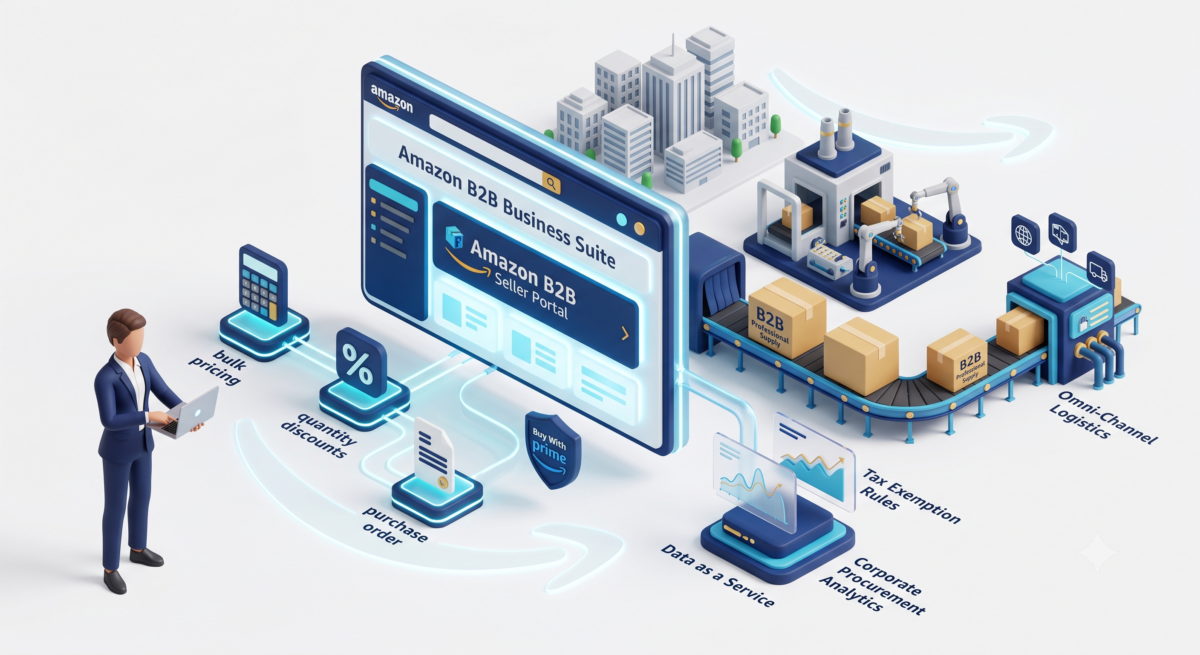
Set business pricing and quantity discounts deliberately. Amazon lets you build up to five tiers of quantity discounts, so a buyer who needs 50 units sees a better per-unit price than one buying five. This is the single most direct lever on average order value, because business buyers are explicitly looking for the volume break. Price it as a throwaway and you train buyers to look elsewhere for the bulk deal.

Chase the Business Savings badge, the blue badge that signals a competitive business price. Products earn it by offering a meaningful discount: roughly 5% off for a single-unit business price, or about 3% on a quantity discount tier. It is worth the margin because of where it shows up. Badged products surface more prominently to business buyers and carry messages like “Save on 10+ units” right on the listing. Given that a large majority of Amazon Business orders flow through the Featured Offer, visibility inside that buying surface is most of the game.

Fill in your credentials, because B2B buyers actually filter on them. Amazon lets sellers display certifications and ownership status: ISO 9001, small business, women-owned, minority-owned, veteran-owned. Many procurement teams have ESG and supplier-diversity targets to hit, and a buyer trying to meet a diversity-spend goal can filter for exactly those flags. If yours are blank, you are invisible to that search. The same goes for manufacturer and distributor part numbers and National Stock Numbers, the identifiers that industrial and government buyers use to match against their internal systems.

Watch the right dashboard. Amazon’s B2B Central inside Seller Central breaks out business-specific metrics: business sales volume, business average order value, repeat purchase rates, which discount tiers buyers actually use. That last one matters. If buyers cluster at your second tier and never reach the third, your tiers are set wrong, and you will only see it in the B2B numbers, not the blended consumer view.

Then the operational basics, which is where the agent story comes back around. Keep prices stable and accurate. Keep inventory honest. Hit your delivery promises. These have always been good practice. In an agent-mediated channel they become the actual ranking signal, the thing software measures you on. A B2B repricing approach that holds steady tends to win more consistent bulk orders, because predictable pricing is what repeat buyers and the systems acting for them reward. Erratic prices and phantom stock are how you get quietly dropped from a reorder.

The parts nobody has fully figured out

It would be dishonest to present this as a clean win with no downside, so here are the threads I am leaving untied, because they genuinely are.

The first is Amazon itself. Amazon sells first-party, and on Amazon Business you may be competing in the same search results as Amazon’s own listings and against other sellers Amazon can see clearly. Building a meaningful share of your B2B revenue on rails Amazon owns is a strategic dependency, and brands should size that risk with open eyes rather than pretend it away.

The second is margin. Bulk buyers want discounts, and the quantity tiers that win their orders eat into your per-unit profit. For some product lines the volume more than compensates. For others it does not, and the honest answer is that you have to run the math per SKU rather than assume the channel is good for everything you sell. It is not.

The third is the one I find most interesting, and the one I cannot resolve for you: how fast, and how completely, will business buyers actually hand ordering to agents? Amazon is building the capability. The capex is real and the early tools are shipping. But adoption is a human question, and procurement is a conservative function by nature. It is possible that agentic buying becomes the norm for MRO categories within a couple of years and barely touches strategic purchasing for a decade. It is possible the rollout is slower and messier than the announcements suggest. I would not bet against the direction. I would be cautious about anyone claiming to know the timeline.

What I am confident about is narrower and, I think, more useful: the work that prepares you for agentic buying is the same work that wins manual buyers today. Accurate pricing, real inventory, kept delivery promises, complete credentials, sensible discount tiers. None of it is wasted if the agent future arrives slowly, and all of it is essential if it arrives fast. That asymmetry is why getting started in 2026 is a low-regret move even under real uncertainty.

Amazon Business in 2026: the short version

Amazon Business is an 8-million-organization, $35-billion channel full of buyers who reorder, buy in volume, and convert at roughly three times the consumer rate, and it is in the middle of an AI buildout that will reward operational reliability over storefront polish. A brand can enter without going all-in, win average order value through tiered pricing and the savings badge, get found through credentials and the Featured Offer, and read its real performance in B2B Central. The brands that tidy up their pricing and inventory data this year are the ones whose products an automated procurement system will still trust to order next year.

The ones still calling it “the same as regular Amazon” will find out, sometime in 2027, that an agent quietly stopped putting them in the cart. Better to be in it now.

Frequently asked questions

Is Amazon Business free?

Registering as a buyer is free, and so is enrolling your brand as a seller. The cost is the underlying Professional selling account at $39.99 a month, which most established sellers already pay. Business Prime, the optional subscription layer with procurement controls, is separate and priced by organization size.

How is Amazon Business different from regular Amazon?

Same warehouses, different buyer and different tools. Amazon Business buyers are procurement managers, facilities leads, and operations staff who buy in volume, reorder, and run purchases through approval workflows. The platform adds business-only pricing, quantity discounts, tax-exempt purchasing, multi-user accounts, and purchase-order support that the consumer storefront does not surface.

How do brands sell on Amazon Business?

Enroll your existing Seller Central account, then expose the SKUs that make sense for bulk and operational buying. The levers that matter most are business pricing with tiered quantity discounts, the Business Savings badge, and a complete set of credentials (certifications, ownership status, and part numbers) so procurement buyers can find and filter you.

Is Amazon Business worth it for brands in 2026?

For most brands with products that organizations buy repeatedly, yes, and the reason is timing. The same accounts buying by hand today are the ones whose reordering gets automated next. Getting your pricing and inventory data clean now is what keeps you in the cart once buying agents take over the routine purchases.

What is agentic buying on Amazon Business?

It is software placing orders on a buyer’s behalf inside their procurement and ERP systems, with no person opening a product page. For recurring categories, an agent validates the terms and reorders automatically. When that happens, accurate pricing, real stock, and kept delivery promises decide who wins, not images or copy.how to sell b2b on amazon how to sell on amazon b2b how to buy b2b on amazon what is b2b on amazon

Categories
E-Commerce

The Need to Break Silo’s

Amazon Vendor Pressures Due to Silos

Amazon customers go to Amazon.com to purchase products they need based on the need for replenishment or an unexpected need. These customers are not remotely aware of the pressure brands and vendors face to ensure they can receive their purchases on the same day or the next day. Many vendors do not understand Amazon’s pressures on businesses until it’s too late. Invisible inefficiencies become large blockers and potential operating challenges that can kill businesses.

At Equity Commerce we have noticed time and again how structural challenges inside organizations/businesses lead to business pressures that inherently impact the performance of the business. A simple situation such as, in what department is the e-commerce team found in? Is it inside marketing, operations, or the sales department. While this may seem trivial the lack of empowerment by the business of the e-commerce team ensures that its not being communicated with during brand negotiations with retailers and marketplaces. In an omnichannel world, retailers are building marketplaces and increasingly want inventory for the online and retail channel. If the -commerce team is in the dark, this leads to chaos and missed opportunities. 

Another pressure point is access to data. Can businesses and brands access all of their data easily to be able to create a 360 degree picture? We see data held inside agencies, agencies reading reports and driving meetings with brands without brands being able to make sense of performance.


The Holistic Solution

It may seem to all be doom and gloom but the solution is that silos need to be broken. It may sound easy but we have seen on countless occasions if the process is not driven by top management or the process is sponsored by C-level executives it leads to regression to past behaviors. 

Many vendors do not understand that by breaking down the silos between departments and staff will in the long run lead to success in all channels. Retailers want to have products on shelves that are available at similar prices at various stores and having channel control over online sales will lead to better margins and profitability. 

Vendors who want to succeed and understand the importance  of data, analytics and total alignment can get in touch. Let’s get started – reach out to us today.  


Categories
E-Commerce

When Should Amazon Vendors Do Audits?

How often should Amazon vendors audit their businesses?

In every business year there are times when the business can take a breath and reflect on what has happened operationally, analytically inside and outside of the business. Amazon vendors have the opportunity to use the end of quarter four (the week after Christmas) and the early parts of the new business year to audit the business. What should vendors do to better understand the performance of their business?


Vendors collect the evidence

In order for an audit to be successful a brand or Amazon vendor should collect all of its data to be able to create a picture/dashboards to understand business performance. Data sources such as Amazon Vendor Central data, social media data, direct-to-customer website sales data, and advertising metrics should be collated in order to understand what happened inside the business. Alternatively business can also use their reporting software to visualize the annual data in order for reports to be created.

Additionally vendors should also audit the various vendors/agencies that are used to perform tasks. Comparing the contract value against performance should also be done to enable discussions/negotiations with these vendors in the following year. At Equity Commerce far too often we see brands and Amazon vendors who are not receiving the return on investment from their vendors  in relations to the fees paid for services rendered. 

Audits should be used as another opportunity to note learnings from a particular event (Prime Day),  post mortems from advertising campaigns that should be shared company wide. Audits will also indicate previously unseen costs or issues that should be noted and prioritized to not occur in the new year.


Keep Amazon Honest

Amazon vendors should also create a playbook or process to audit Amazon’s performace by asking for monthly or quarterly meetings to ensure that suucess can be achived. Amazon vendors should also audit their Amazon fees, charge backs to ensure that they are not being incorrectly being billed.

We’d very much like to hear about your marketplace pain points and serve as your guide on the audit journey. Let’s get started – reach out to us today.  

Categories
E-Commerce

Amazon Vendors Do You Understand Your Inefficiencies?

The day Amazon vendors receive their access to Vendor Central is supposed to be a day of happiness, but it’s actually a very important moment in your business. While Amazon consultants will make your business believe it is the easiest way to generate sales from Amazon without too much risk, the reality is far from it. While selling your products to Amazon via a wholesale relationship is easier than being a seller on the platform, your business inefficiencies will quickly become more visible. These inefficiencies if not monitored or solved has the potential to kill your business without management being aware of it. 


What are business inefficiencies?

What most Amazon vendors do not recognize or are aware of, is that Amazon is a data company first. Amazon likely has determined whether the vendor’s product selection is fit for a particular category and customers’ current intent for these products. Amazon also has determined which products are being searched for by their customers that are leading to no results or results that are not leading to products being added to shopping carts. 

By the time Amazon sends Vendor Central access, it is likely that they know more about your business than what they will make known to the vendor. 


Examples of business inefficiencies

  • Is the business contribution profit negative or profitable? Does the business know how many of your products are profitable? Not many Amazon vendors have this information in hand or know this offhand. 

  • Does the business have access to the right tools related to reporting to ensure that they have a 360-degree view of their vendor business without the need for Amazon’s reporting? Understanding your analytics is important to keep Amazon honest about investments in promotions and advertising. SKU-level reporting is critical to ensure that investment is only done on profitable ASINs. 

  • Does the brand have its resellers/distributors under control to ensure that no sales can be made to Amazon without the brand’s consent? Amazon has used distributors to grow their selection, but brands should ensure channel control is established and retained. A lack of channel control will negatively impact pricing as Amazon compares SKUs across platforms to offer customers the best pricing available. 

What can vendors do to fix these inefficiencies?

Amazon vendors should understand their business, look at analytics related to sales, partners/vendors used and look at their Amazon inventory. Asking resellers or distributors for data as part of their contracts to sell your inventory is critical in understanding what is really happening with your online business.

Understanding your product mix such as what are your hero SKUs or what are loss leaders. Importantly understanding margins which should not be blended but rather be based per SKU should quickly showcase which advertising campaigns should be stopped to ensure that profitability can occur. The use of custom reporting and the right software that can showcase opportunities or pitfalls which might not be visible is key for long term sustainability.

Let Equity Commerce help you resolve these ineffincies and become a sustainable and profitable Amazon vendor or seller. Let’s get started – reach out to us today.  


Categories
E-Commerce

July Prime Day Opportunity & Post-Mortem

Amazon finally announced Prime Day on July 11 and 12, 2023. The most exciting part of the announcement – the launch of an invite list, which customers must request access to – to access deals that will likely sell out.  

We still see brands that are hesitant to sell on Amazon. We also see brands more hesitant about Prime Day due to margin squeezing. 

Vendors must understand what Prime Day is and is not. Amazon has created a two-day event to sell branded devices, offer exclusive promotions to Prime members, and sell advertising. Notice what is not mentioned – profitability and margins.

There is no secret sauce or quick road to success on Prime Day. Prime Day planning should start the day after the event for the following year’s event or when Amazon announces an event for October.

The  2023 Innovation – Moving Away From Amazon

Is Amazon using Prime Day as the first opportunity for brands to drive traffic off of Amazon to other domains? 

Or is this another case of Amazon adding additional value to the Buy with Prime program by leveraging Prime Day to promote products not on Amazon’s marketplace?

Prime Day Tactics For Success

Brands and vendors ensure you are marketing products with profit margins. Are these ASINs available for both event days?

Vendors ensure that you have inventory planned to be moved to Amazon warehouses. Vendors likely will see slim margins if they have not negotiated promotions for products with positive margins.

What is the one thing Amazon vendors want but get relatively little coverage? Net income and net revenues. Net revenues have a variety of Amazon acronyms, but do vendors know what this means?

How To Validate Whether Prime Day Was Successful

  • If it’s profitable and with margin – fantastic work done by your team.
  • If it’s remotely profitable with lower margins – your Amazon team has done better than most vendors.
  • If it is not profitable and with no margins – Amazon has won, and your team needs assistance. 

It is about making net margins and profit daily, monthly, and annually.

Post Prime Day Activities To Aid Festive Season Goals

Brands and vendors, what did you learn from Prime Day 2023 from day one data? Did you have ASINs run out of stock, or did your advertising budget get blown into a million pieces? Did your advertising campaigns perform as you expected or not?

Every year, Prime Day is when brands and vendors learn how customers perceive your brand, how your team performed during the event, and what analytics are needed to move the needle.

A debrief/report of what happened that contains data review, learnings, and challenges faced. What worked or did not generate sales or revenues as expected?

Use the data provided by Amazon and from solution partners to create a picture of what happened over the 48 hours of Prime Day. Many brands do not use Prime Day as a dress rehearsal for Q4.

Categories
E-Commerce

The Importance of Product Differentiation

Attention: Amazon Vendors — Embrace Product Differentiation Before You Consider Abandoning the Vendor Central 1P Ship.

If you work, support, or frequently talk with Amazon vendors (those whose products are purchased directly by Amazon) you’ll note that the biggest challenges (in no certain order) are profit margins, annual cost increases during AVN, and the creeping sense of doom. Semi-kidding about the doom.  To be more precise, vendors tend to share the pervasive feeling that – compared to Amazon 1P – there must be more advantageous sales channels and/or a better business model than Amazon 1P. 

While it might seem easy to offer or suggest a range of solutions based on the challenges noted above, the reality is that every brand, product category, and scenario includes nuance and complications. 

“Should a brand sell on every marketplace, and leverage marketplace diversification to prevent or mitigate Amazon dependence?”

While it might sound compelling to sell every item in your catalog everywhere.  Please proceed with caution! Experienced vendors, who’ve been there and done that, will no doubt perk up with the understanding that complete marketplace diversification has the potential to create a problem capable of quickly growing to the size of the Incredible Hulk.


Amazon is no longer the only game in town. Over the last five years or so, numerous other retailers have created dozens of online marketplaces that enable product-buying customers to not only just buy in-store but to buy online and pick up same-day in a preferred parking “fast lane” or just like Amazon, purchase online for home delivery. 

Be careful what you wish for. Since Amazon is no longer the only (or primary) marketplace for vendors to sell via a “platform” – there are hazards many have not fully considered. Products being spread across multiple markets almost always negatively impacts 1P vendors. 

Here’s why: Unless vendors have truly differentiated their products by sales channel, any level of product similarity will immediately trigger Amazon’s price-matching web spiders and algorithms. From a product-purchasing customer’s perspective, you can almost always guarantee that Amazon’s price will be the same if not lower than other online marketplaces.  Here’s how Amazon speaks to that: “We constantly compare Amazon’s prices to our competitors’ prices to make sure that our prices are as low or lower than all relevant competitors. As a result, we don’t offer price matching.”

What they fail to mention is that they are constantly scouring the web to ensure that prices for every ASIN are not being undercut by other retailers for the exact same SKU.

What’s a Vendor To Do?

While we are pragmatists and realists, we know this next suggestion will take time.  But with that said,  we firmly believe that Amazon 1P vendors must ensure that every product sold on every discrete sales channel should include unique and different packaging while at the same time eliminating all duplicated data points.  This means by channel, a product should not share similar descriptors such as barcodes, GTINs, or SKUs

It’s a really big ask.  We get it.

But we’ve seen this pay major dividends, here are the tactical elements to keep in mind:

  • Be sure you understand your best-selling items based on each unique sales channel and do all you can to differentiate those items to ensure there are not comparable and/or used against you, as the vendor, by any platform.
  • If your products are found to be similar, Amazon will match the lowest price which means your margins decrease. 
  • Differentiate your product’s packaging, the item’s name, and even the colors of the products for each sales channel. Not only does this help to make price matching more difficult, but it also provides vendors a quick visual tool for identifying “leaky” sales channels (for example, now you can see when/if a Walmart-only SKU appears on Amazon). 
  • Create bundles to develop an additional layer of differentiation for each channel and then relaunch the most successful products as Amazon exclusives.  

Differentiation of product selection is a powerful tool and the first step to creating (and sustaining) better margins on Amazon. This process takes time, capital, and long-term planning.  But getting it right will help to ensure that your business is running efficiently as possible.

Please reach out to our team today!  We’d love to hear your questions about this latest post.

Categories
E-Commerce

2023 Prime Day Prep

Can you believe it’s already the second week of May? If you are thinking about what exactly, is looming for the next 90 days, we hope you can say Prime Day preparation has been completed. If not, please note that the submission window for Prime Day member deals and lightning deals has likely passed by the time you read this. 

When is Prime Day 2023? Amazon has not officially announced this year’s date for Prime Day, but increasingly, it looks like smart money suggests it will happen during the second week of July. 

So what must a 1P vendor do to prepare for Prime Day 2023?

  1. Evaluate the product detail pages for all of the promotional ASINs. 
  2. Plan for inventory demand before Prime Day.

Product Detail Page (PDP) Evaluations

In preparation for Prime Day – 14 days to go:
  • Are there any incorrect variations listed on this ASIN? Ensure that only the correct variations are linked to the Parent ASIN. 
  • What is the current share of voice for this product, organic versus paid? Are customers currently finding this ASIN through search advertising only, or is it due to high rankings for specific keywords? 
  • Check keywords to ensure that customers can find your products quickly. Video content on the product detail pages drives conversions. 
During the days leading up to Prime Day:
  • What, if any, content for your Prime Day ASIN(s) has changed – including reviews, stars, and customer questions?  Stay on top, and create a baseline.
  • What are the competitive changes related to the share of voice and/or deals offered for similar ASINs by competitors?
  • 3P offers by ASIN – did any of your partners sell below the minimum advertised price?
  • Were there any pricing changes in the preceding days on non-Amazon websites? Ensure that buy box suppression is not accidentally triggered by another promotion. 
  • Total price change per ASIN – was pricing elasticity upwards or downwards?

Inventory demand

  • Look at your forecasts for July – do you have enough stock in FBA warehouses, and have you also planned for a spike in sales? Amazon will enforce chargebacks and reroute customer traffic if your product is out of stock. If needed – plan to drop ship merchandise to FBA warehouses.
  • Reserve a specific amount of stock that you can dropship. 

Let Equity Commerce help you ensure that Prime Day 2023 is a success.  Reach out today.  

Categories
Buy With Prime E-Commerce

How Should Brands Think About Amazon Costs?

Multi-Channel Fulfillment (MCF) costs are increasing – is Fulfillment by Amazon (FBA) next?

What will happen with 1P brands and vendors currently under negotiations with Amazon?

It’s almost the end of April 2023 and time for some reflection and honesty. Let’s face it, 2023 has been challenging so far.  We’ve seen layoffs at most of the large incumbents (Amazon, Microsoft, Meta, Google, and others), inflation, while virtually all businesses are looking for cost savings at every customer touch point. 

So what does this all mean for Amazon 3P sellers and 1P vendors? In the simplest terms, it means higher expenses and difficult negotiations. MCF has already seen a price increase and it’s likely it will be even more expensive as we approach Q4. 

Amazon will no doubt use Prime Day to demand more deals from brands of all shapes and sizes and will likely also use the always-crazy fourth quarter as another inflection point to increase costs associated with shipping, warehouse space, etc. 

Brands and vendors are almost certainly facing a year in which Amazon only gets more (and more) expensive. 

What can you do to manage these costs?

Frequent readers of this blog know how much emphasis we place on brands possessing a thorough understanding of their unit economics.  Use that data (again, at an ASIN level) to negotiate as hard as possible with Amazon to ensure you have some protective measures related to margins and profits. 

Don’t despair! 

Throwing your hands in the air if you just don’t care is simply enough.  We get it. 

Brands are in a tough position, is Amazon nothing more than a necessary evil?  Hmmm, where else (besides Amazon) can you sell as many units, reach as massive of a purchasing audience, and generate as much revenue as you do today, selling via Amazon?

The answer is nowhere. Currently, no other platform as powerful as Amazon exists.

But fear not, we suggest using 2023 as the year in which you remove those non-performing ASINs from your Amazon account and begin to sell via other channels such as your Direct-to-consumer (DTC) website. If you’re smart, and we have faith in you, you should also leverage Buy with Prime (BwP) to reach as many of those 157 million plus Prime members. 

Be strategic about the new products you add to the mix on Amazon.  Does this product generate enough margin and profit for your business? If the answer is no – do not list it. 

For lower-priced products (less than $50 per unit) bundle them together to grow your average order value (AOV).  And in case you missed the memo, selling any item for less than $10/unit on Amazon is akin to throwing money away.  Your order volumes would need to be MASSIVE to generate a profit. 

In addition, our internal research has shown that in many cases sellers are competing against lower pricing from sellers from completely other markets, like those where sellers can survive with either smaller labor needs and/or pay for more staffing at lower costs. 

Getting into an Amazon price war with these brands will not end well. 

Do you have a “leaky” Amazon sales channel?  Are you competing with a roster of unauthorized resellers selling your product on, or to Amazon?  If so, talk to us about creating and implementing an authorized reseller program.  Do it now!

Have a plan! Ensure that you have an ironclad minimum advertised price (MAP) policy for your distributors and resellers. Also, ensure that your manufacturing partners are contractually prevented from reselling your products to, or on, Amazon. Competing against your own partners is a recipe for migraines and diminishing returns!

Bottomline: Brands/sellers should control as much of their brand and product Amazon ecosystem as possible!  Accentuate the positive and do everything in your power to ensure that Amazon’s impending cost increases (winter is coming!) do not effectively kill your best-selling products or business. 

We’d very much like to hear about your marketplace pain points and serve as your guide on this journey. Let’s get started – reach out to us today.  

Categories
E-Commerce

Top 3 Amazon Vendor Negotiation Tips

As of mid-April 2023, most Amazon 1P vendor brands are either attending Amazon Vendor Negotiations (AVN) also known as Joint Business Plans (JBP), or in the initial stages of working with their vendor manager to create a business plan for 1P sales for the next 12 months. 

Here are a few tips designed to help vendors prepare for AVNs.

1. Download your sales and operations data from Vendor Central.

Brands should already have this habit, but in prep for AVNs go to Vendor Central, download the agreement, and prepare notes on the core elements of the latest agreement. Pay special attention to allowances (marketing and freight), terms (base and payment), incentives (volume), and pay-to-play programs.

2. Know your true 1P costs.

Ensure you and your team have a thorough understanding of costs – both on and off of Amazon. Calculate all the costs related to selling via 1P. What are your PPM (Pure Product Margin), Net PPM, and Operating Margin? Same for your off-of-Amazon costs.

PPM (Pure Product Margin) – This is based on the wholesale prices Amazon pays for your items in 1P purchase orders. PPM reveals the ratio of net profits to revenue.

Net PPM – This factors in all the operational costs that it takes to operate on Amazon’s platform such as labor costs of your Amazon team (or agency), logistics, and purchase order processing. 

Operating Margin – Net PPM plus other costs that Amazon charges brands for not ensuring that the relevant products are available to consumers. < Proposed: This is the operating income minus all operating expenses including variable costs for production, wages, and raw materials

3. Ask the right questions.

When you can speak with your vendor manager – ask the right questions. Ask for details on how marketing development funds (MDF) were used at an ASIN level. Which ASINs were used during promotions and marketing events, and how did this impact customer impression numbers and of course, sales?

The Amazon Vendor Negotiation (AVN) process is potentially stressful but if you plan accordingly, and prepare scenarios and questions that are both relevant and attainable, you can help to ensure that the entire AVN process is beneficial to your brand. 

This can be a complicated process full of moving parts, so take the time to prepare to ensure that your team is adequately informed and ready to interact in a meaningful way with your Amazon vendor manager. 

If you agree, disagree, or would like to debate any of this, please reach out to Equity Commerce today.  We look forward to hearing from you.