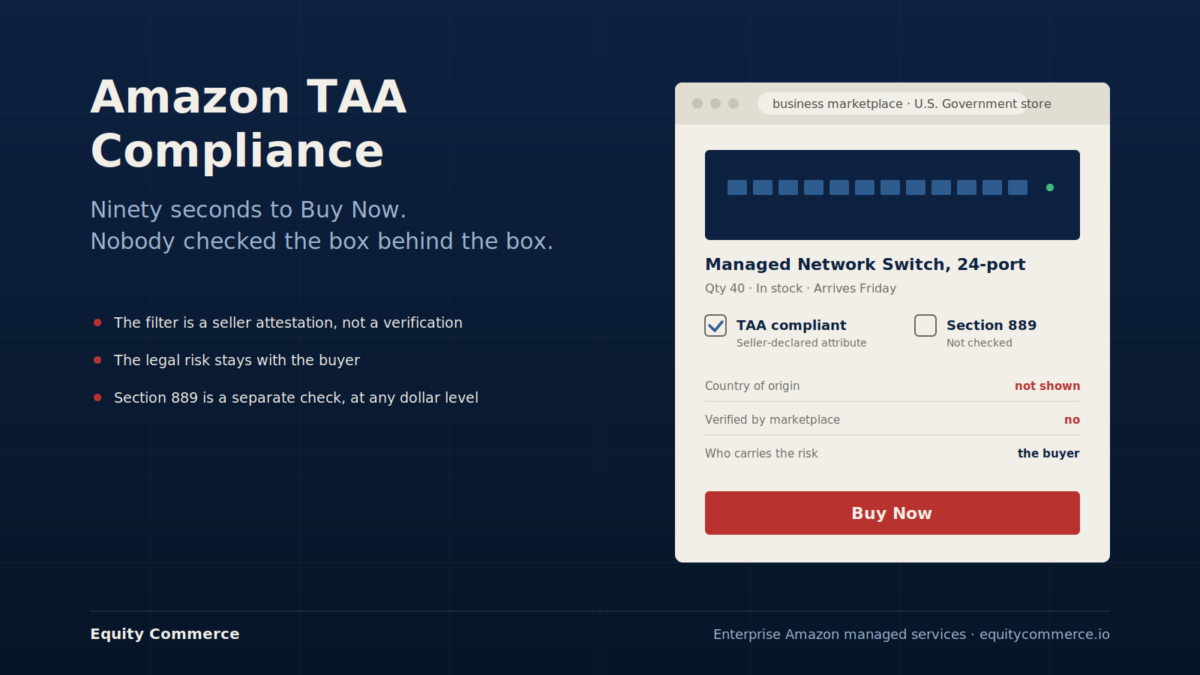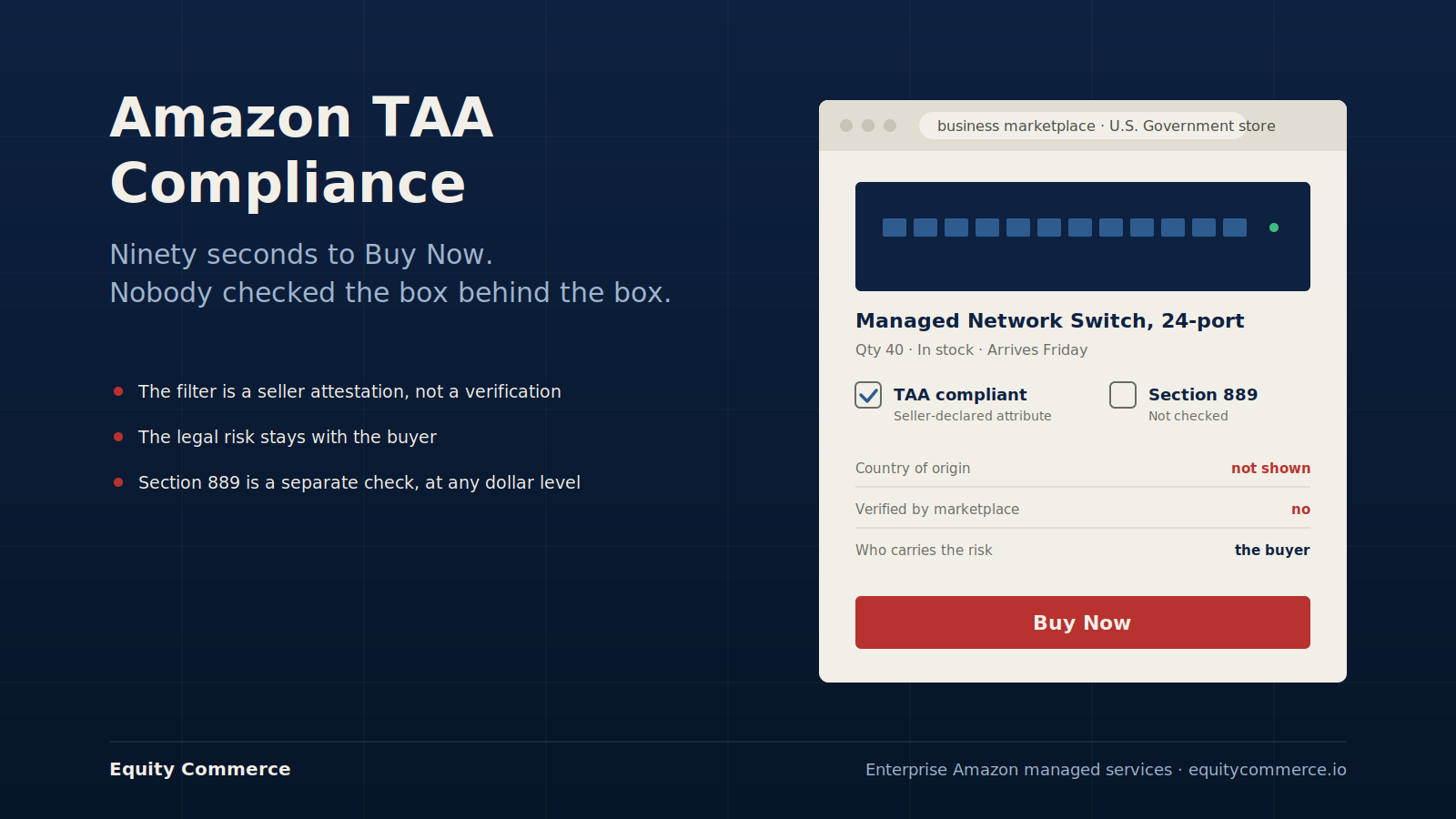

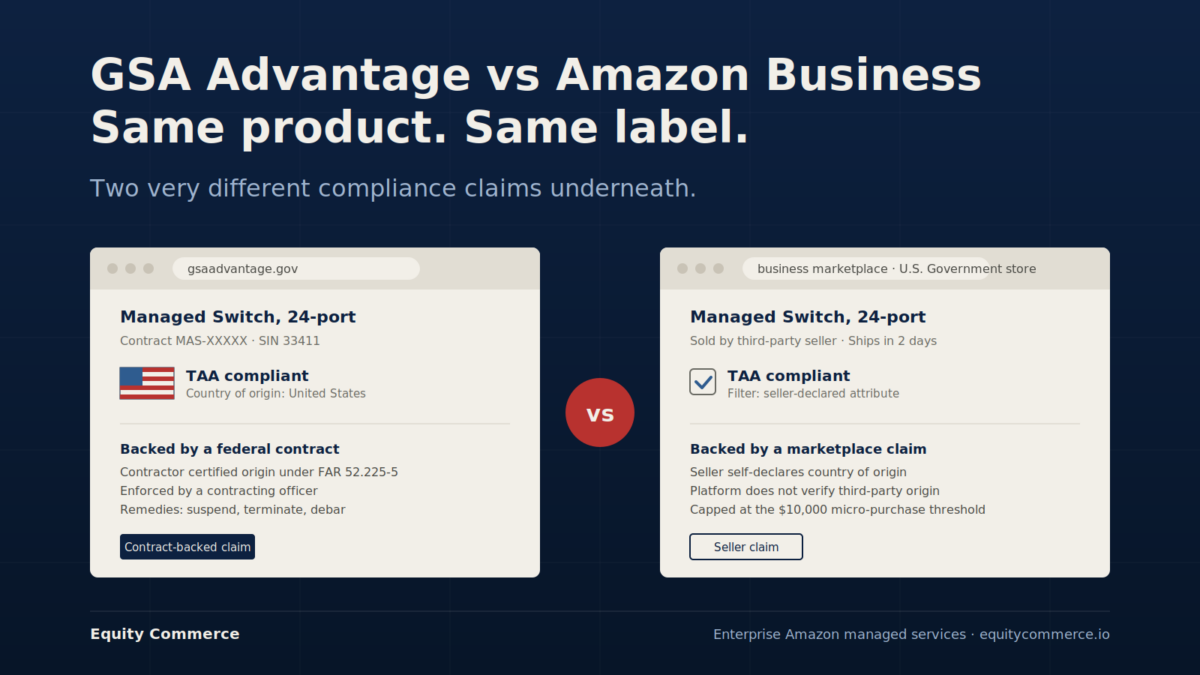
A federal card-holder needs a specific model of managed switch. They have to decide whether GSA Advantage vs Amazon Business can enable them to procure the items needed in an appropriate manner. They likely will open two tabs. One is GSA Advantage, the government’s own online marketplace. It lists products from GSA Multiple Award Schedule contractors. The other is Amazon Business. Amazon is one of eight platform providers in GSA’s Commercial Platforms program. Both surface the same switch. Both label it TAA compliant. The compliance claims behind those two labels are not the same.
That difference is the reason for this GSA Advantage vs Amazon Business comparison. Federal agencies move between the two sites every day. Most do not notice that the compliance and enforcement structures beneath run on different logic. Understanding the split changes what an agency buys where. It also changes the evidence in an audit.
Short answer: GSA Advantage is the more ironclad platform on TAA compliance. Every product listed there flows from a MAS contract. The contractor has certified country of origin as part of that contract. U.S. products get an American flag icon on the listing. Amazon Business is a marketplace with third-party seller claims. The claim is lighter. GSA has active enforcement infrastructure. In 2026 it removed 22 falsely labeled Chinese flatware products from GSA Advantage after joint action with SBA. Amazon Business wins on catalog breadth, speed, and daily usability. Both fall under the $10,000 micro-purchase cap. That cap sits in the Commercial Platforms program. In short, that covers the GSA Advantage vs Amazon Business trade-off.
What Is GSA Advantage?
GSA Advantage is the General Services Administration’s online marketplace for federal buying. It launched in 1995. That was decades before Amazon Business existed. It remains the government’s main online buying tool. Federal agencies use it to buy products and services. The sellers are vendors who hold GSA Multiple Award Schedule contracts, the government’s largest contracting vehicle.
The catalog runs deep. GSA Advantage lists more than ten million products. Categories include IT hardware and software, office supplies, industrial products, medical equipment, services, and vehicles. Roughly a million buyers visit the site each week. They place on the order of 30,000 orders in that time. Contract holders range from Fortune 500 makers to small businesses. Many small businesses pursue a GSA Schedule as their federal sales channel.
What makes GSA Advantage unlike a private site is what sits behind every listing. A product is not offered by a seller who signed up for a vendor account. It is offered by a company that has been through a GSA bid round. That company has agreed on pricing and executed a contract. The contract binds it to federal clauses. Those clauses include FAR 52.225-5 for Trade Agreements Act compliance, cybersecurity requirements, and price reduction terms. Price reductions trigger if the vendor gives their customers a better deal. Every price and product claim on GSA Advantage traces back to those contract terms.
That structural difference is why the site is sometimes called the government’s Amazon. Sometimes it is called something else entirely. The interface is similar. The legal underpinning is not.
GSA Advantage vs Amazon Business: How the Two Marketplaces Differ
GSA Advantage is run directly by the General Services Administration. It is the government’s own e-commerce site. Every product listed there is offered by a company holding a Multiple Award Schedule contract. The vendor has been through a GSA bid round. It has agreed on pricing. It has agreed to a package of contract clauses. Those clauses include FAR 52.225-5, the Trade Agreements Act clause. The catalog holds over ten million items. Roughly a million buyers visit each week. They place about 30,000 orders in that time.
Amazon Business is a private site with a U.S. Government storefront layered on top. Its participation in federal buying runs through the GSA Commercial Platforms program. Section 846 of the FY2018 NDAA created the program. It launched in June 2020. Amazon is one of eight platform providers. The others are e-Procurement Services, Fisher Scientific, G-Commerce, Grainger, NOBLE, Pacific Ink, and Staples. Purchases through the program are capped at the $10,000 micro-purchase threshold. Amazon Business offers filters for Buy American Act and Trade Agreements Act claims. It also flags Section 889 certified sellers, AbilityOne products, and small and veteran-owned businesses.
The user experience diverges quickly. GSA Advantage feels like a government buying site, because it is one. Search relevance is uneven. The interface is dated. The assortment reflects who bothered to get on Schedule. Amazon Business feels like Amazon, because it is Amazon. The catalog is deeper. Shipping is faster. The search just works. The pick rarely turns on features. It comes down to what compliance setting the buyer is comfortable working in. In any GSA Advantage vs Amazon Business decision, that comfort level is what matters.
Who Can Buy on GSA Advantage?
Federal Agencies
All federal agencies qualify. All executive, legislative, and judicial federal entities can purchase through GSA Advantage. The law is 40 U.S.C. Section 502. That includes the Department of Defense, civilian agencies, and separate agencies.
State, Local, and Tribal Governments
State, local, and tribal governments have narrower but real access under four distinct laws. The Cooperative Purchasing Program is the biggest. It was established under Section 211 of the E-Government Act of 2002. The program opened Schedule 70 for state and local buyers. Schedule 70 is now MAS Large Category F (Information Technology). It also opened Schedule 84, now Large Category J (Law Enforcement, Security, Facilities Management, Fire, and Rescue). Any state or local buying purpose qualifies.
The Disaster Purchasing Program is the second law. Section 833 of the John Warner NDAA for FY2007 established it. State and local governments can use any Federal Supply Schedule under this program. The use has to facilitate recovery from major disasters, terrorism, or nuclear, biological, chemical, or radiological attacks.
The Public Health Emergencies Program is the third. It opens Schedule access when the Secretary of HHS declares a public health emergency. This law was used during COVID-19. The 1122 Program is the fourth. It lets state and local purchases of counter-drug, homeland security, and emergency response equipment.
Contractors and Other Eligible Buyers
Contractors performing cost-reimbursement work for the U.S. can also purchase on GSA Advantage. The purchase has to be for use in performing those contracts. Federally funded research and development centers can buy. Tribal governments can buy. Certain FAA-approved entities can buy.
The practical result is that GSA Advantage is a broader marketplace than most people realize. A county sheriff’s office can buy body cameras under Schedule 84 access. A state university’s IT department can buy under Schedule 70. A city responding to a hurricane can buy under Section 833. Not every state or local buyer knows they have this option. Eligibility rules are category-specific. The first step is checking the right schedule law before ordering.
What the American Flag Icon Actually Certifies
GSA Advantage displays a small American flag icon next to U.S.-origin products. That icon is not a marketing device. According to GSA’s own guidance, MAS contractors confirm the country of origin for each product listed. U.S. products get the flag. The claim is a written claim. It is not a self-service checkbox on a marketplace. If the claim is wrong, it is wrong against the terms of a federal contract. The machinery for handling that is well established.
GSA also gives buyers a clear route to act. If product marketing suggests a non-TAA country of make, buyers can use the Report Incorrect Product Listing feature. Contracting officers have access to supply chain data. That data flags possibly non-compliant products. This is a working loop with a clear route to act.
On Amazon Business, the equivalent claim is a seller claim displayed in a filter. Amazon does not make most of what it sells. It does not verify country of origin for third-party products. It does not have GSA’s contract-based hold over sellers. The filter is useful. It is a lighter claim than the flag icon on GSA Advantage. Both should be double-checked for high-value or sensitive buys. Only one is backed by a MAS contract.
The Case That Shows Both Systems Under Stress
In 2026, the Small Business Administration announced a coordinated action with GSA. They removed 22 falsely labeled foreign-made flatware product offerings from GSA Advantage. The concern was that China-based companies were marketing products as “Made in America.” The products were allegedly only partially assembled or finished in the United States. SBA also flagged the broader risk. Agencies could have purchased foreign-made goods under misleading domestic-origin claims. That would possibly violate the Buy American Act, TAA, and related country-of-origin rules.
Two things are worth pulling out of that case. The system worked, because products were identified and removed. The system also failed, because they were there in the first place. The MAS claim model catches things. It does not prevent them. Contractors who move production, mislabel components, or simply lie can populate GSA Advantage with non-compliant items. Enforcement catches up eventually. The flag icon is a strong claim. It is not a guarantee.
In the GSA Advantage vs Amazon Business comparison, the key question is different. What would the equivalent case look like on Amazon Business? There is no equivalent public enforcement action to point to. That is not because Amazon Business is cleaner. It is because Amazon’s compliance setup does not run through a contracting officer. There is no subpoena-level access to supply chain data. There is no public-affairs office ready to announce removals. When Amazon takes non-compliant products down, it does so quietly. It moves on its own schedule, on its own terms. Buyers do not see the same cleanup trail.
The Regulatory Push Toward Domestic Sourcing
The comparison is not static. On June 24, 2026, GSA issued a Request for Information. It proposed two approaches for promoting Made-in-America products on GSA Advantage. Compliant products would receive a distinctive icon. They would sort to the top of search results. Comments were due July 24. This came out of Executive Order 14392. The EO requires GSA to periodically review and verify country-of-origin claims. That includes Buy American Act, Country of Origin USA, and similar American-origin claims.
Proposed FAR Part 7 amendments were issued around the same time. They encourage buying planners to consider what U.S. sources can supply during planning. The direction of travel is unambiguous. More checking is coming. More prominence for U.S.-origin products is coming. More enforcement of country-of-origin claims is coming. GSA Advantage is the platform being reshaped first, because GSA directly controls it. Any Made-in-America premium the government builds into GSA Advantage will produce parallel pressure on Amazon Business. Amazon will have to match it or explain why it cannot.
Contractors on either platform should read the RFI as a signal. Country-of-origin claims are now surface area for audit. FedBiz Access, in its coverage of the RFI, put it plainly. Contractors should read continued enforcement as a signal, not a one-time cleanup. The GSA Advantage vs Amazon Business rules are both tightening.
Where GSA Advantage Wins on TAA Compliance
In the GSA Advantage vs Amazon Business comparison, four structural advantages tilt in GSA Advantage’s favor for compliance purposes.
The vetting happens upfront through the Schedule award process. A vendor selling on GSA Advantage has already passed through a bid round. That bid round required TAA compliance claims. The gate is stronger than site signup. Site signup mostly checks that a seller is real.
Every listing is tied to a contract that names the compliance clauses. If a product on GSA Advantage is misrepresented, the enforcement path runs through contract law. It does not run through site terms. Contracting officers can suspend, terminate, and debar. Those are real remedies.
Supply chain data flows to contracting officers automatically. Amazon Business is not built to route seller data to a federal contracting officer. It is not a federal contract.
The Report Incorrect Product Listing feature is a real route to act. It has a stated policy of action. That is unlike a site complaint form.
Where Amazon Business Wins
The GSA Advantage vs Amazon Business ledger also runs the other way. Two things Amazon Business does better matter enough to name.
Catalog breadth and speed. Amazon Business has more of what agencies need to buy day-to-day. It delivers faster. GSA Advantage is a real site with real inventory. But some are thin there. General office supplies, common electronics, and daily consumables often show more depth on Amazon. GSA Advantage cannot always match Amazon’s assortment or logistics. This is why marketplace providers were let into federal buying.
Buyer experience under time pressure. Anyone who has done end-of-fiscal-year buying knows one thing. GSA Advantage’s search does not always surface the right product on the first try. Amazon Business does. For high-volume, low-risk buys, the time savings are real.
The Commercial Platforms program’s $10,000 micro-purchase ceiling is a built-in admission. These advantages are worth having on small buys. On small buys, TAA doesn’t apply. Letting them loose on larger, TAA-covered procurements is too risky.
When to Use Which
Most GSA Advantage vs Amazon Business decisions come down to threshold and category. For anything above the micro-purchase threshold, GSA Advantage or a direct MAS order is the safer choice. TAA-covered products belong there. The contract-based compliance setup gives contracting officers a sound record. It gives the vendor a sound defense. If a challenge comes, the paper trail runs through a formal claim. That claim is tied to a federal contract, not to a marketplace claim.
For sub-threshold buys where TAA is not the operative rule, Amazon Business is sound if used carefully. Agency policy still requires country-of-origin awareness. The buyer should use the filter. The buyer should keep a record of what filter state produced which purchase. The buyer should not rely on the filter as a legal opinion. This is the daily case. It is where Amazon Business’s speed and catalog earn their place.
For any purchase involving Section 889 covered categories, both platforms need extra checking. Video surveillance and telecommunications equipment fall in this bucket. Buyers need to verify the Section 889 flag as well as the TAA claim. The two rules work apart. A product can clear one while failing the other.
For high-sensitivity types, either marketplace is a starting point, not a stopping point. Cybersecurity gear, laboratory instruments, and DoD-adjacent electronics fit here. Checking country of origin against maker records is where real compliance happens.
How to Sell on GSA Advantage
Applying for a Multiple Award Schedule Contract
Selling on GSA Advantage requires holding a GSA Multiple Award Schedule contract. The path to that contract is a real buying process, not a marketplace signup. Vendors register in SAM.gov. They obtain a Unique Entity Identifier. Then they submit a MAS offer through GSA’s eOffer system. The offer package includes private pricing history and proposed Government pricing. It also includes technical qualifications, past-performance information, and proof of solvency.
Negotiating Pricing and Contract Terms
A GSA contracting officer sets the terms. Two commercial questions dominate the talk. Most Favored Customer pricing is the first. It asks what discounts the vendor gives its best customer. It asks whether the government can have those or better. The Basis of Award is the second. It defines the customer relationship whose pricing GSA’s award tracks going forward. Get these wrong and the contract locks in unfavorable terms for years.
Uploading Your Catalog to GSA Advantage
Once awarded, the vendor uploads its approved product list to GSA Advantage. The upload uses the Schedules Input Program or the newer Formatted Product Tool. Country-of-origin claims for each product line are part of the product upload. TAA-compliant products earn the American flag icon here. Products cannot legitimately appear on GSA Advantage without executing this step.
Ongoing Obligations and Contract Timeline
Ongoing duties matter more than the initial award. Schedule holders pay a 0.75 percent Industrial Funding Fee on all Schedule sales. They remit it quarterly. They file sales reports through the FAS Sales Reporting Portal. The Price Reductions Clause requires notifying GSA when the vendor gives their customers a better deal. That notification can trigger a matching reduction in Government pricing. TAA compliance is a continuing claim, not a one-time claim. Vendors are expected to update country-of-origin claims when a maker moves production.
Timeline from application to award often runs six to twelve months. Contract terms are five years. Three five-year options can extend that. That runs up to twenty years total. Small businesses benefit from set-aside opportunities. Many use a GSA Schedule as the entry point to federal contracting. The compliance overhead is real. For vendors serving federal, and now state and local, buyers, the volume the Schedule opens up often justifies it.
GSA Advantage vs Amazon Business: The Comparison Nobody Runs Enough
Contracting staff who work in both sites daily have a common pattern. They trust GSA Advantage more on compliance. They trust Amazon Business more on execution. That is a rational split. What is worth interrogating is how often the split is made consciously. Often it is inertia. Buyers default to whichever tab is already open. They default to whichever site their card is set up for. They are not really choosing. The interface is choosing for them.
The right question for a buying office is not who wins the GSA Advantage vs Amazon Business debate. It is which categories go through which platform, and why. Common consumables, ordinary IT accessories, and low-risk supplies do not need a MAS contract behind them. Anything with a country-of-origin risk profile probably does. Electronics and communications sit at the top of that list. That policy talk is worth having explicitly. Most agencies have not had it.
GSA is now reshaping GSA Advantage. Those changes will widen the compliance gap between the two sites, at least on paper. Whether that gap reduces non-compliant buying is a separate question. It depends on whether agencies route the right buys to the right place. It also depends on whether the flag icon holds up as an enforcement tool day to day. The June 2026 RFI process will produce answers. Those answers will change this comparison.
For now, the GSA Advantage vs Amazon Business picture is simple. The two platforms are tools for different jobs. Treating them as interchangeable is how agencies pick the wrong tool for the buys that matter.
Frequently Asked Questions
What is GSA Advantage?
GSA Advantage is the General Services Administration’s online marketplace for federal buying. It launched in 1995 and lists more than ten million products. Sellers hold GSA Multiple Award Schedule contracts. Federal agencies use it as their main online buying tool. Eligible state, local, and tribal entities can also access specific schedules. The laws include the Cooperative Purchasing Program and the Disaster Purchasing Program.
Who can buy on GSA Advantage?
All federal executive, legislative, and judicial branch agencies can buy under 40 U.S.C. Section 502. State, local, and tribal governments can access Schedule 70 (IT) and Schedule 84 (law enforcement and security). That access is under the Cooperative Purchasing Program, created under Section 211 of the E-Government Act of 2002. They can also access any Federal Supply Schedule during disaster recovery, under Section 833 of the Warner NDAA. HHS-declared public health emergencies open Schedule access as well. Contractors performing cost-reimbursement work for the U.S. can also buy through GSA Advantage.
How do I sell on GSA Advantage?
You need a GSA Multiple Award Schedule contract. Register in SAM.gov. Submit an offer through eOffer. Negotiate terms with a GSA contracting officer. Two commercial questions matter most: Most Favored Customer pricing and Basis of Award. Execute the contract when terms are agreed. Then upload your catalog via the Schedules Input Program or Formatted Product Tool. Country-of-origin claims attach at that step. Timeline often runs six to twelve months. Contract terms are five years with three five-year options. Ongoing duties include a 0.75 percent Industrial Funding Fee, quarterly sales reporting, and continued TAA compliance.
What is the difference between GSA Advantage and Amazon Business?
The GSA Advantage vs Amazon Business comparison starts with who runs each platform. GSA Advantage is the U.S.-run e-commerce site, operated by GSA. It lists products from vendors on Multiple Award Schedule contracts. Amazon Business is a private site. It participates in federal buying through GSA’s Commercial Platforms program. GSA Advantage relies on contract-based country-of-origin claims. Amazon Business relies on marketplace seller claims.
What are the TAA compliance requirements for federal agencies?
Federal agencies must apply the Trade Agreements Act to buys above the WTO Government Procurement Agreement threshold. That threshold is roughly $183,000 for supply and service contracts in 2026. FAR Part 25.4 sets out the framework. FAR 52.225-5 is the clause contracting officers include in covered bid rounds and contracts. Above the threshold, agencies can only buy end products from the United States or from a designated country. Below the threshold, Buy American Act preferences apply instead. Agencies rely on contractor claims of country of origin. They also retain separate responsibility to verify them when red flags appear. Section 889 prohibitions on covered telecommunications and video surveillance equipment apply at any dollar level.
Is GSA Advantage more TAA compliant than Amazon Business?
In the GSA Advantage vs Amazon Business comparison on TAA compliance, GSA Advantage’s model is legally stronger. MAS contractors are bound by FAR 52.225-5. They confirm country of origin as part of their contract. U.S.-made products carry an American flag icon. Amazon Business relies on seller self-claims displayed as filters. Both marketplaces have limits. Both should be verified for high-value buys.
What does the American flag icon on GSA Advantage mean?
It shows the MAS contractor has certified the product as U.S.-made. The claim runs under the terms of the GSA Schedule contract. It is a formal claim, not a marketing badge. If the claim is inaccurate, GSA has enforcement mechanisms. Those include a Report Incorrect Product Listing feature and coordination with SBA and DOJ.
Which marketplace should a federal agency use?
The GSA Advantage vs Amazon Business choice depends on threshold and risk. For sub-threshold daily buys where speed matters and country-of-origin risk is low, Amazon Business is sound. It runs through the Commercial Platforms program. For anything above the $10,000 micro-purchase threshold, use GSA Advantage or a direct MAS order. TAA-covered categories and high-risk sourcing belong there. Either provides a stronger compliance record.
What are the risks of non-compliance in federal buying?
Non-compliance can trigger False Claims Act liability with treble damages. Per-claim penalties run $14,308 to $28,619. Contract termination is a common consequence. So is removal from GSA Schedule and suspension or debarment from future federal contracting. In serious cases, DOJ pursues criminal charges for wire fraud and conspiracy. Qui tam whistleblowers file most TAA cases. They are often competitors or former employees. They receive 15 to 30 percent of any recovery. That is what makes the enforcement system self-executing. Past-performance records also carry the violation forward into future bid evaluations. Reputational damage from a public deal can outlast the money penalty. For agency buyers, the exposure is different but real. It includes audit findings, inspector general reports, and required returns of non-compliant inventory.
Are Amazon Business and GSA Advantage subject to the same rules?
The GSA Advantage vs Amazon Business rulebook overlaps but is not the same. Both are subject to TAA above the applicable threshold. Both are subject to Section 889 across all categories. The difference is in how compliance is documented and enforced. GSA Advantage sits inside a contract structure. Amazon Business sits inside a site structure with a lighter claim layer.
Sources and Further Reading
- GSA guidance: Trade Agreements Act compliance and supply chain security on MAS
- GSA Commercial Platforms Program awarded platforms
- GAO reports on GSA’s Commercial Platforms program
- SBA and GSA joint announcement on removal of 22 falsely labeled flatware products
- Executive Order 14392 and GSA Request for Information (June 24, 2026)
- FAR 52.225-5 Trade Agreements clause
- Section 846 of the NDAA for Fiscal Year 2018
- Section 211 of the E-Government Act of 2002 (Cooperative Purchasing Program)
- Section 833 of the John Warner NDAA for Fiscal Year 2007 (Disaster Purchasing)