
Categories
E-Commerce

GSA Advantage vs Amazon Business: Which Federal Marketplace Is More TAA Compliant?

A federal card-holder needs a specific model of managed switch. They have to decide whether GSA Advantage vs Amazon Business can enable them to procure the items needed in an appropriate manner. They likely will open two tabs. One is GSA Advantage, the government’s own online marketplace. It lists products from GSA Multiple Award Schedule contractors. The other is Amazon Business. Amazon is one of eight platform providers in GSA’s Commercial Platforms program. Both surface the same switch. Both label it TAA compliant. The compliance claims behind those two labels are not the same.

That difference is the reason for this GSA Advantage vs Amazon Business comparison. Federal agencies move between the two sites every day. Most do not notice that the compliance and enforcement structures beneath run on different logic. Understanding the split changes what an agency buys where. It also changes the evidence in an audit.

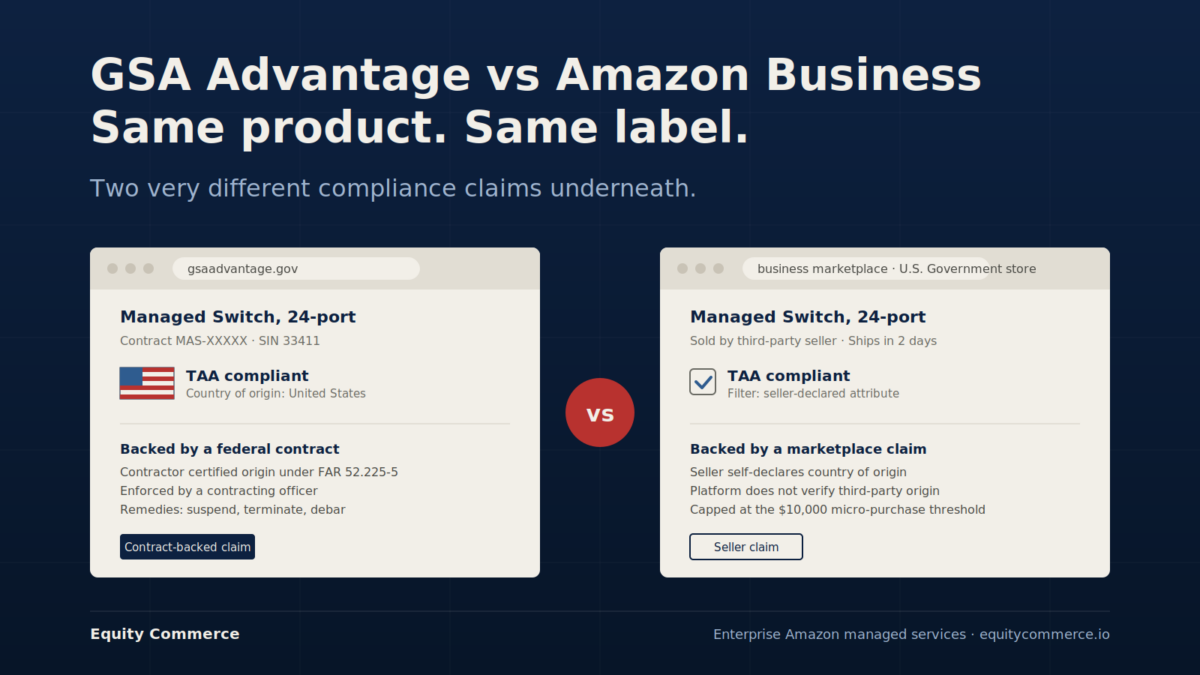
Short answer: GSA Advantage is the more ironclad platform on TAA compliance. Every product listed there flows from a MAS contract. The contractor has certified country of origin as part of that contract. U.S. products get an American flag icon on the listing. Amazon Business is a marketplace with third-party seller claims. The claim is lighter. GSA has active enforcement infrastructure. In 2026 it removed 22 falsely labeled Chinese flatware products from GSA Advantage after joint action with SBA. Amazon Business wins on catalog breadth, speed, and daily usability. Both fall under the $10,000 micro-purchase cap. That cap sits in the Commercial Platforms program. In short, that covers the GSA Advantage vs Amazon Business trade-off.

What Is GSA Advantage?

GSA Advantage is the General Services Administration’s online marketplace for federal buying. It launched in 1995. That was decades before Amazon Business existed. It remains the government’s main online buying tool. Federal agencies use it to buy products and services. The sellers are vendors who hold GSA Multiple Award Schedule contracts, the government’s largest contracting vehicle.

The catalog runs deep. GSA Advantage lists more than ten million products. Categories include IT hardware and software, office supplies, industrial products, medical equipment, services, and vehicles. Roughly a million buyers visit the site each week. They place on the order of 30,000 orders in that time. Contract holders range from Fortune 500 makers to small businesses. Many small businesses pursue a GSA Schedule as their federal sales channel.

What makes GSA Advantage unlike a private site is what sits behind every listing. A product is not offered by a seller who signed up for a vendor account. It is offered by a company that has been through a GSA bid round. That company has agreed on pricing and executed a contract. The contract binds it to federal clauses. Those clauses include FAR 52.225-5 for Trade Agreements Act compliance, cybersecurity requirements, and price reduction terms. Price reductions trigger if the vendor gives their customers a better deal. Every price and product claim on GSA Advantage traces back to those contract terms.

That structural difference is why the site is sometimes called the government’s Amazon. Sometimes it is called something else entirely. The interface is similar. The legal underpinning is not.

GSA Advantage vs Amazon Business: How the Two Marketplaces Differ

GSA Advantage is run directly by the General Services Administration. It is the government’s own e-commerce site. Every product listed there is offered by a company holding a Multiple Award Schedule contract. The vendor has been through a GSA bid round. It has agreed on pricing. It has agreed to a package of contract clauses. Those clauses include FAR 52.225-5, the Trade Agreements Act clause. The catalog holds over ten million items. Roughly a million buyers visit each week. They place about 30,000 orders in that time.

Amazon Business is a private site with a U.S. Government storefront layered on top. Its participation in federal buying runs through the GSA Commercial Platforms program. Section 846 of the FY2018 NDAA created the program. It launched in June 2020. Amazon is one of eight platform providers. The others are e-Procurement Services, Fisher Scientific, G-Commerce, Grainger, NOBLE, Pacific Ink, and Staples. Purchases through the program are capped at the $10,000 micro-purchase threshold. Amazon Business offers filters for Buy American Act and Trade Agreements Act claims. It also flags Section 889 certified sellers, AbilityOne products, and small and veteran-owned businesses.

The user experience diverges quickly. GSA Advantage feels like a government buying site, because it is one. Search relevance is uneven. The interface is dated. The assortment reflects who bothered to get on Schedule. Amazon Business feels like Amazon, because it is Amazon. The catalog is deeper. Shipping is faster. The search just works. The pick rarely turns on features. It comes down to what compliance setting the buyer is comfortable working in. In any GSA Advantage vs Amazon Business decision, that comfort level is what matters.

Who Can Buy on GSA Advantage?

Federal Agencies

All federal agencies qualify. All executive, legislative, and judicial federal entities can purchase through GSA Advantage. The law is 40 U.S.C. Section 502. That includes the Department of Defense, civilian agencies, and separate agencies.

State, Local, and Tribal Governments

State, local, and tribal governments have narrower but real access under four distinct laws. The Cooperative Purchasing Program is the biggest. It was established under Section 211 of the E-Government Act of 2002. The program opened Schedule 70 for state and local buyers. Schedule 70 is now MAS Large Category F (Information Technology). It also opened Schedule 84, now Large Category J (Law Enforcement, Security, Facilities Management, Fire, and Rescue). Any state or local buying purpose qualifies.

The Disaster Purchasing Program is the second law. Section 833 of the John Warner NDAA for FY2007 established it. State and local governments can use any Federal Supply Schedule under this program. The use has to facilitate recovery from major disasters, terrorism, or nuclear, biological, chemical, or radiological attacks.

The Public Health Emergencies Program is the third. It opens Schedule access when the Secretary of HHS declares a public health emergency. This law was used during COVID-19. The 1122 Program is the fourth. It lets state and local purchases of counter-drug, homeland security, and emergency response equipment.

Contractors and Other Eligible Buyers

Contractors performing cost-reimbursement work for the U.S. can also purchase on GSA Advantage. The purchase has to be for use in performing those contracts. Federally funded research and development centers can buy. Tribal governments can buy. Certain FAA-approved entities can buy.

The practical result is that GSA Advantage is a broader marketplace than most people realize. A county sheriff’s office can buy body cameras under Schedule 84 access. A state university’s IT department can buy under Schedule 70. A city responding to a hurricane can buy under Section 833. Not every state or local buyer knows they have this option. Eligibility rules are category-specific. The first step is checking the right schedule law before ordering.

What the American Flag Icon Actually Certifies

GSA Advantage displays a small American flag icon next to U.S.-origin products. That icon is not a marketing device. According to GSA’s own guidance, MAS contractors confirm the country of origin for each product listed. U.S. products get the flag. The claim is a written claim. It is not a self-service checkbox on a marketplace. If the claim is wrong, it is wrong against the terms of a federal contract. The machinery for handling that is well established.

GSA also gives buyers a clear route to act. If product marketing suggests a non-TAA country of make, buyers can use the Report Incorrect Product Listing feature. Contracting officers have access to supply chain data. That data flags possibly non-compliant products. This is a working loop with a clear route to act.

On Amazon Business, the equivalent claim is a seller claim displayed in a filter. Amazon does not make most of what it sells. It does not verify country of origin for third-party products. It does not have GSA’s contract-based hold over sellers. The filter is useful. It is a lighter claim than the flag icon on GSA Advantage. Both should be double-checked for high-value or sensitive buys. Only one is backed by a MAS contract.

The Case That Shows Both Systems Under Stress

In 2026, the Small Business Administration announced a coordinated action with GSA. They removed 22 falsely labeled foreign-made flatware product offerings from GSA Advantage. The concern was that China-based companies were marketing products as “Made in America.” The products were allegedly only partially assembled or finished in the United States. SBA also flagged the broader risk. Agencies could have purchased foreign-made goods under misleading domestic-origin claims. That would possibly violate the Buy American Act, TAA, and related country-of-origin rules.

Two things are worth pulling out of that case. The system worked, because products were identified and removed. The system also failed, because they were there in the first place. The MAS claim model catches things. It does not prevent them. Contractors who move production, mislabel components, or simply lie can populate GSA Advantage with non-compliant items. Enforcement catches up eventually. The flag icon is a strong claim. It is not a guarantee.

In the GSA Advantage vs Amazon Business comparison, the key question is different. What would the equivalent case look like on Amazon Business? There is no equivalent public enforcement action to point to. That is not because Amazon Business is cleaner. It is because Amazon’s compliance setup does not run through a contracting officer. There is no subpoena-level access to supply chain data. There is no public-affairs office ready to announce removals. When Amazon takes non-compliant products down, it does so quietly. It moves on its own schedule, on its own terms. Buyers do not see the same cleanup trail.

The Regulatory Push Toward Domestic Sourcing

The comparison is not static. On June 24, 2026, GSA issued a Request for Information. It proposed two approaches for promoting Made-in-America products on GSA Advantage. Compliant products would receive a distinctive icon. They would sort to the top of search results. Comments were due July 24. This came out of Executive Order 14392. The EO requires GSA to periodically review and verify country-of-origin claims. That includes Buy American Act, Country of Origin USA, and similar American-origin claims.

Proposed FAR Part 7 amendments were issued around the same time. They encourage buying planners to consider what U.S. sources can supply during planning. The direction of travel is unambiguous. More checking is coming. More prominence for U.S.-origin products is coming. More enforcement of country-of-origin claims is coming. GSA Advantage is the platform being reshaped first, because GSA directly controls it. Any Made-in-America premium the government builds into GSA Advantage will produce parallel pressure on Amazon Business. Amazon will have to match it or explain why it cannot.

Contractors on either platform should read the RFI as a signal. Country-of-origin claims are now surface area for audit. FedBiz Access, in its coverage of the RFI, put it plainly. Contractors should read continued enforcement as a signal, not a one-time cleanup. The GSA Advantage vs Amazon Business rules are both tightening.

Where GSA Advantage Wins on TAA Compliance

In the GSA Advantage vs Amazon Business comparison, four structural advantages tilt in GSA Advantage’s favor for compliance purposes.

The vetting happens upfront through the Schedule award process. A vendor selling on GSA Advantage has already passed through a bid round. That bid round required TAA compliance claims. The gate is stronger than site signup. Site signup mostly checks that a seller is real.

Every listing is tied to a contract that names the compliance clauses. If a product on GSA Advantage is misrepresented, the enforcement path runs through contract law. It does not run through site terms. Contracting officers can suspend, terminate, and debar. Those are real remedies.

Supply chain data flows to contracting officers automatically. Amazon Business is not built to route seller data to a federal contracting officer. It is not a federal contract.

The Report Incorrect Product Listing feature is a real route to act. It has a stated policy of action. That is unlike a site complaint form.

Where Amazon Business Wins

The GSA Advantage vs Amazon Business ledger also runs the other way. Two things Amazon Business does better matter enough to name.

Catalog breadth and speed. Amazon Business has more of what agencies need to buy day-to-day. It delivers faster. GSA Advantage is a real site with real inventory. But some are thin there. General office supplies, common electronics, and daily consumables often show more depth on Amazon. GSA Advantage cannot always match Amazon’s assortment or logistics. This is why marketplace providers were let into federal buying.

Buyer experience under time pressure. Anyone who has done end-of-fiscal-year buying knows one thing. GSA Advantage’s search does not always surface the right product on the first try. Amazon Business does. For high-volume, low-risk buys, the time savings are real.

The Commercial Platforms program’s $10,000 micro-purchase ceiling is a built-in admission. These advantages are worth having on small buys. On small buys, TAA doesn’t apply. Letting them loose on larger, TAA-covered procurements is too risky.

When to Use Which

Most GSA Advantage vs Amazon Business decisions come down to threshold and category. For anything above the micro-purchase threshold, GSA Advantage or a direct MAS order is the safer choice. TAA-covered products belong there. The contract-based compliance setup gives contracting officers a sound record. It gives the vendor a sound defense. If a challenge comes, the paper trail runs through a formal claim. That claim is tied to a federal contract, not to a marketplace claim.

For sub-threshold buys where TAA is not the operative rule, Amazon Business is sound if used carefully. Agency policy still requires country-of-origin awareness. The buyer should use the filter. The buyer should keep a record of what filter state produced which purchase. The buyer should not rely on the filter as a legal opinion. This is the daily case. It is where Amazon Business’s speed and catalog earn their place.

For any purchase involving Section 889 covered categories, both platforms need extra checking. Video surveillance and telecommunications equipment fall in this bucket. Buyers need to verify the Section 889 flag as well as the TAA claim. The two rules work apart. A product can clear one while failing the other.

For high-sensitivity types, either marketplace is a starting point, not a stopping point. Cybersecurity gear, laboratory instruments, and DoD-adjacent electronics fit here. Checking country of origin against maker records is where real compliance happens.

How to Sell on GSA Advantage

Applying for a Multiple Award Schedule Contract

Selling on GSA Advantage requires holding a GSA Multiple Award Schedule contract. The path to that contract is a real buying process, not a marketplace signup. Vendors register in SAM.gov. They obtain a Unique Entity Identifier. Then they submit a MAS offer through GSA’s eOffer system. The offer package includes private pricing history and proposed Government pricing. It also includes technical qualifications, past-performance information, and proof of solvency.

Negotiating Pricing and Contract Terms

A GSA contracting officer sets the terms. Two commercial questions dominate the talk. Most Favored Customer pricing is the first. It asks what discounts the vendor gives its best customer. It asks whether the government can have those or better. The Basis of Award is the second. It defines the customer relationship whose pricing GSA’s award tracks going forward. Get these wrong and the contract locks in unfavorable terms for years.

Uploading Your Catalog to GSA Advantage

Once awarded, the vendor uploads its approved product list to GSA Advantage. The upload uses the Schedules Input Program or the newer Formatted Product Tool. Country-of-origin claims for each product line are part of the product upload. TAA-compliant products earn the American flag icon here. Products cannot legitimately appear on GSA Advantage without executing this step.

Ongoing Obligations and Contract Timeline

Ongoing duties matter more than the initial award. Schedule holders pay a 0.75 percent Industrial Funding Fee on all Schedule sales. They remit it quarterly. They file sales reports through the FAS Sales Reporting Portal. The Price Reductions Clause requires notifying GSA when the vendor gives their customers a better deal. That notification can trigger a matching reduction in Government pricing. TAA compliance is a continuing claim, not a one-time claim. Vendors are expected to update country-of-origin claims when a maker moves production.

Timeline from application to award often runs six to twelve months. Contract terms are five years. Three five-year options can extend that. That runs up to twenty years total. Small businesses benefit from set-aside opportunities. Many use a GSA Schedule as the entry point to federal contracting. The compliance overhead is real. For vendors serving federal, and now state and local, buyers, the volume the Schedule opens up often justifies it.

GSA Advantage vs Amazon Business: The Comparison Nobody Runs Enough

Contracting staff who work in both sites daily have a common pattern. They trust GSA Advantage more on compliance. They trust Amazon Business more on execution. That is a rational split. What is worth interrogating is how often the split is made consciously. Often it is inertia. Buyers default to whichever tab is already open. They default to whichever site their card is set up for. They are not really choosing. The interface is choosing for them.

The right question for a buying office is not who wins the GSA Advantage vs Amazon Business debate. It is which categories go through which platform, and why. Common consumables, ordinary IT accessories, and low-risk supplies do not need a MAS contract behind them. Anything with a country-of-origin risk profile probably does. Electronics and communications sit at the top of that list. That policy talk is worth having explicitly. Most agencies have not had it.

GSA is now reshaping GSA Advantage. Those changes will widen the compliance gap between the two sites, at least on paper. Whether that gap reduces non-compliant buying is a separate question. It depends on whether agencies route the right buys to the right place. It also depends on whether the flag icon holds up as an enforcement tool day to day. The June 2026 RFI process will produce answers. Those answers will change this comparison.

For now, the GSA Advantage vs Amazon Business picture is simple. The two platforms are tools for different jobs. Treating them as interchangeable is how agencies pick the wrong tool for the buys that matter.

Frequently Asked Questions

What is GSA Advantage?

GSA Advantage is the General Services Administration’s online marketplace for federal buying. It launched in 1995 and lists more than ten million products. Sellers hold GSA Multiple Award Schedule contracts. Federal agencies use it as their main online buying tool. Eligible state, local, and tribal entities can also access specific schedules. The laws include the Cooperative Purchasing Program and the Disaster Purchasing Program.

Who can buy on GSA Advantage?

All federal executive, legislative, and judicial branch agencies can buy under 40 U.S.C. Section 502. State, local, and tribal governments can access Schedule 70 (IT) and Schedule 84 (law enforcement and security). That access is under the Cooperative Purchasing Program, created under Section 211 of the E-Government Act of 2002. They can also access any Federal Supply Schedule during disaster recovery, under Section 833 of the Warner NDAA. HHS-declared public health emergencies open Schedule access as well. Contractors performing cost-reimbursement work for the U.S. can also buy through GSA Advantage.

How do I sell on GSA Advantage?

You need a GSA Multiple Award Schedule contract. Register in SAM.gov. Submit an offer through eOffer. Negotiate terms with a GSA contracting officer. Two commercial questions matter most: Most Favored Customer pricing and Basis of Award. Execute the contract when terms are agreed. Then upload your catalog via the Schedules Input Program or Formatted Product Tool. Country-of-origin claims attach at that step. Timeline often runs six to twelve months. Contract terms are five years with three five-year options. Ongoing duties include a 0.75 percent Industrial Funding Fee, quarterly sales reporting, and continued TAA compliance.

What is the difference between GSA Advantage and Amazon Business?

The GSA Advantage vs Amazon Business comparison starts with who runs each platform. GSA Advantage is the U.S.-run e-commerce site, operated by GSA. It lists products from vendors on Multiple Award Schedule contracts. Amazon Business is a private site. It participates in federal buying through GSA’s Commercial Platforms program. GSA Advantage relies on contract-based country-of-origin claims. Amazon Business relies on marketplace seller claims.

What are the TAA compliance requirements for federal agencies?

Federal agencies must apply the Trade Agreements Act to buys above the WTO Government Procurement Agreement threshold. That threshold is roughly $183,000 for supply and service contracts in 2026. FAR Part 25.4 sets out the framework. FAR 52.225-5 is the clause contracting officers include in covered bid rounds and contracts. Above the threshold, agencies can only buy end products from the United States or from a designated country. Below the threshold, Buy American Act preferences apply instead. Agencies rely on contractor claims of country of origin. They also retain separate responsibility to verify them when red flags appear. Section 889 prohibitions on covered telecommunications and video surveillance equipment apply at any dollar level.

Is GSA Advantage more TAA compliant than Amazon Business?

In the GSA Advantage vs Amazon Business comparison on TAA compliance, GSA Advantage’s model is legally stronger. MAS contractors are bound by FAR 52.225-5. They confirm country of origin as part of their contract. U.S.-made products carry an American flag icon. Amazon Business relies on seller self-claims displayed as filters. Both marketplaces have limits. Both should be verified for high-value buys.

What does the American flag icon on GSA Advantage mean?

It shows the MAS contractor has certified the product as U.S.-made. The claim runs under the terms of the GSA Schedule contract. It is a formal claim, not a marketing badge. If the claim is inaccurate, GSA has enforcement mechanisms. Those include a Report Incorrect Product Listing feature and coordination with SBA and DOJ.

Which marketplace should a federal agency use?

The GSA Advantage vs Amazon Business choice depends on threshold and risk. For sub-threshold daily buys where speed matters and country-of-origin risk is low, Amazon Business is sound. It runs through the Commercial Platforms program. For anything above the $10,000 micro-purchase threshold, use GSA Advantage or a direct MAS order. TAA-covered categories and high-risk sourcing belong there. Either provides a stronger compliance record.

What are the risks of non-compliance in federal buying?

Non-compliance can trigger False Claims Act liability with treble damages. Per-claim penalties run $14,308 to $28,619. Contract termination is a common consequence. So is removal from GSA Schedule and suspension or debarment from future federal contracting. In serious cases, DOJ pursues criminal charges for wire fraud and conspiracy. Qui tam whistleblowers file most TAA cases. They are often competitors or former employees. They receive 15 to 30 percent of any recovery. That is what makes the enforcement system self-executing. Past-performance records also carry the violation forward into future bid evaluations. Reputational damage from a public deal can outlast the money penalty. For agency buyers, the exposure is different but real. It includes audit findings, inspector general reports, and required returns of non-compliant inventory.

Are Amazon Business and GSA Advantage subject to the same rules?

The GSA Advantage vs Amazon Business rulebook overlaps but is not the same. Both are subject to TAA above the applicable threshold. Both are subject to Section 889 across all categories. The difference is in how compliance is documented and enforced. GSA Advantage sits inside a contract structure. Amazon Business sits inside a site structure with a lighter claim layer.

Sources and Further Reading

  • GSA guidance: Trade Agreements Act compliance and supply chain security on MAS
  • GSA Commercial Platforms Program awarded platforms
  • GAO reports on GSA’s Commercial Platforms program
  • SBA and GSA joint announcement on removal of 22 falsely labeled flatware products
  • Executive Order 14392 and GSA Request for Information (June 24, 2026)
  • FAR 52.225-5 Trade Agreements clause
  • Section 846 of the NDAA for Fiscal Year 2018
  • Section 211 of the E-Government Act of 2002 (Cooperative Purchasing Program)
  • Section 833 of the John Warner NDAA for Fiscal Year 2007 (Disaster Purchasing)
Categories
E-Commerce

Amazon TAA Compliance: How to Find and Sell TAA-Compliant Products

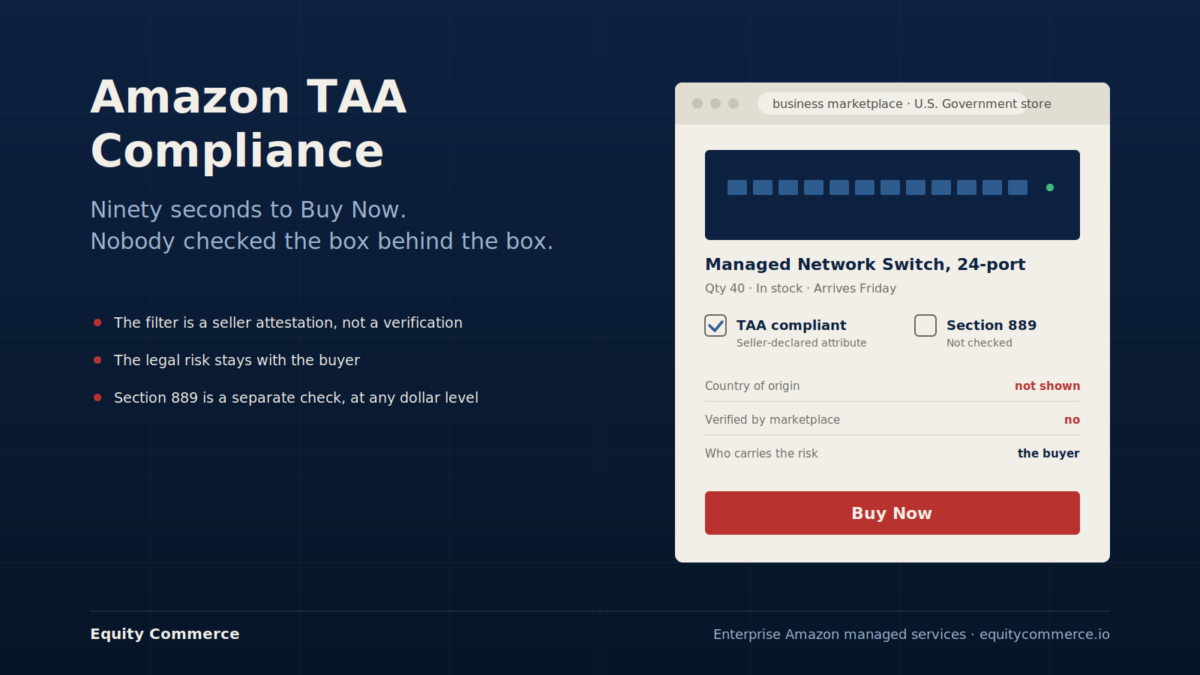
Amazon TAA compliance: a government marketplace listing for network switches with a seller-declared TAA compliant filter, country of origin not shown, and the risk carried by the buyer

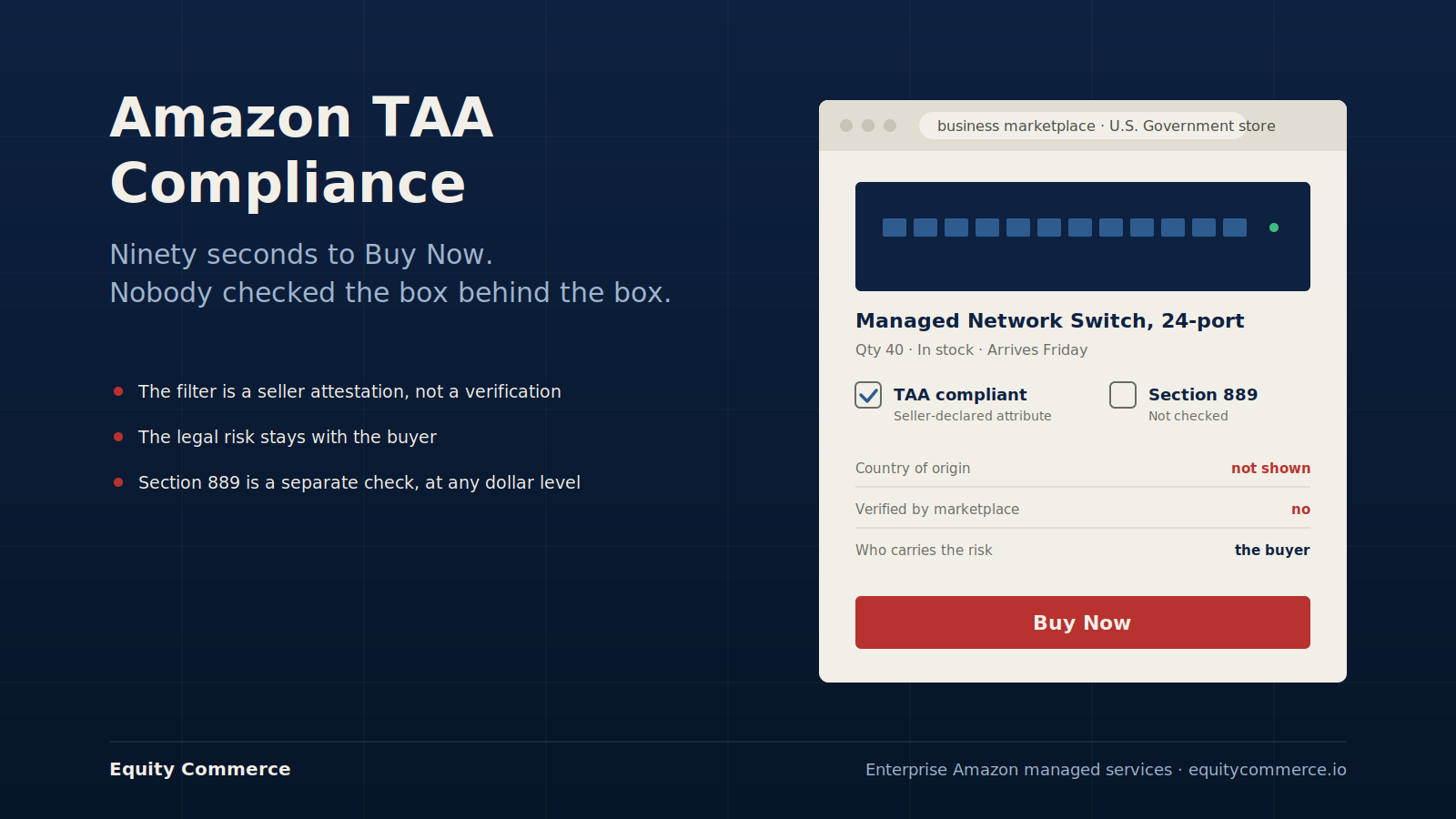
A program manager at a county water authority needs forty network switches by Friday. She opens her government Amazon Business account, filters for what’s in stock, and clicks Buy Now. The whole thing takes about ninety seconds. What she may not realize is that whether those switches are Amazon TAA compliant can decide whether her agency just made a legal purchase or an illegal one, and the catalog let her buy either way.

Short answer: Amazon Business does sell TAA-compliant products, and its U.S. Government storefront lets you filter for them using seller attestations under the Trade Agreements Act. But an “Amazon TAA compliant” label is not something Amazon independently verifies. It is a box a third-party seller checked, and the legal risk for getting it wrong stays with the buyer. The rest of this guide covers what TAA compliance means, how to find TAA-compliant products on Amazon, which countries qualify in 2026, what it takes to sell compliant goods, and where the storefront’s filter quietly stops protecting you.

What “TAA Compliant” Actually Means

The Trade Agreements Act of 1979, codified at 19 U.S.C. 2501 and following, exists to implement a stack of international trade agreements the United States has signed, chief among them the World Trade Organization’s Government Procurement Agreement. The practical effect is simpler than the statute. Above a certain dollar threshold, the federal government may only buy products that come from the United States or from a “designated country,” meaning a country that has agreed to open its own government markets to U.S. goods in return.

A product earns TAA-compliant status one of two ways. It is wholly grown or manufactured in the United States or a designated country, or it was “substantially transformed” in such a country into a new article with a different name, character, or use. A circuit board fabricated in Taiwan and then built into a finished server in Mexico can qualify, because the final assembly substantially transformed the components into something distinct. Where that transformation happened is the country of origin for TAA purposes.

Two wrinkles catch sellers off guard. When origin is genuinely contested, the binding answer often comes from U.S. Customs and Border Protection, which issues final determinations on where a product was substantially transformed. CBP has weighed in on hard cases like cloud-based software, where the line between real transformation and mere assembly gets slippery fast. The second wrinkle is that the rule works differently for services. A service’s country of origin turns on where the company performing it is established, meaning where it is incorporated or headquartered, so a U.S.-domiciled firm can use workers abroad and still qualify.

Here is the point that causes the most confusion. Plenty of sellers, and some contracting staff, believe TAA compliance turns on whether more than half the manufacturing cost originates in qualifying countries. It does not. That fifty-percent-of-cost logic belongs to the Buy American Act, a separate statute with its own domestic-content math. TAA uses the substantial transformation test, which is about the nature of the manufacturing step, not a tally of component costs. Mixing the two leads people to certify products with the wrong yardstick entirely, which is exactly the error that surfaces during an audit.

The dollar threshold matters because the rule only switches on above it. As of 2026 the WTO GPA threshold for most supply and service contracts sits around $183,000, and it gets revised on a roughly two-year cycle, so the precise figure drifts (recent sources have cited numbers from $174,000 to $183,000). Some free-trade-agreement partners trigger at lower amounts. Below the threshold, TAA does not formally apply, and the more familiar Buy American preferences take over. That threshold is the loophole, the safety valve, and the reason most marketplace buying escapes the heaviest scrutiny. Hold that thought.

TAA-Compliant Countries in 2026 (and the Ones That Don’t Count)

The designated-country list runs to roughly 120 nations. It includes most of Western Europe, Canada, Japan, South Korea, Taiwan, Australia, and dozens of smaller economies. The list matters most for who is missing. China is not a designated country. Neither is India, Russia, Indonesia, Malaysia, Brazil, or Thailand. So a hard drive assembled in Shenzhen, a desk lamp molded in Malaysia, or a uniform sewn in India generally fails the TAA test on its face, no matter how good the price or how fast the shipping.

This is why country of origin, not brand, is the thing to read on a listing. A keyboard “Made in Taiwan” can be compliant because Taiwan is designated. The same model from a Chinese line is not. The official designated-country list lives in the Federal Acquisition Regulation and on GSA’s vendor resources, and it is worth checking against rather than guessing, because the membership shifts as trade agreements change.

How to Find TAA-Compliant Products on Amazon

Amazon Business runs a U.S. Government storefront aimed at federal, state, local, and education buyers. This is where most of the compliance machinery an ordinary card-holder will touch actually lives. The storefront lets you filter for products carrying seller attestations under both the Buy American Act and the Trade Agreements Act. It also surfaces Section 889 certified sellers, AbilityOne products, and goods from small and veteran-owned businesses.

For centralized federal accounts, Amazon maintains a deliberately limited pool of TAA-eligible items and asks agencies to email a dedicated address, AB-TAA@amazon.com, to request access. The company is candid that this pool is small, citing higher manufacturing costs and thinner supply chains for compliant goods, and that most of those TAA items have nearly identical non-compliant twins available to everyone else on the site.

Concrete examples make the pattern clear. Logitech sells a “TAA-compliant version” of its Rally Bar video conferencing kit specifically for government rooms. Adesso and Kensington list smart-card-reader keyboards labeled TAA compliant and Made in Taiwan, marketed for federal and military buyers. Buffalo Americas flags networking gear made in Japan as TAA compliant. Allied Telesis sells PCIe fiber adapters with the TAA badge. The common thread is not the brand. It is a stated country of origin that is the United States or a designated country, paired with a seller willing to attest to it.

The honest way to read all of this: the storefront filter and the curated catalog are useful starting points, and for routine sub-threshold buying they are probably adequate. They are not a substitute for confirming country of origin on anything sensitive or high-volume.

Is the “Amazon TAA Compliant” Label Trustworthy?

Here is where I’ll take a position. Amazon does not manufacture most of what it sells. The U.S. Government storefront, like the rest of the marketplace, leans heavily on third-party sellers, who now account for roughly two-thirds of units sold across Amazon overall. Country-of-origin information on a listing comes from the seller, by self-attestation. The seller checks the box. Amazon displays the result. Amazon is not auditing, factory by factory, where each item was substantially transformed.

You can see why the model is built this way. Amazon’s catalog runs to hundreds of millions of items, and independently verifying the provenance of each against the substantial transformation test would be slow and probably impossible at that scale. Self-attestation is the only mechanism that fits the volume. It is also the mechanism that quietly relocates the legal risk.

Think through who is exposed when an attestation is wrong. The seller made a representation, but the agency that bought the item, and any prime contractor reselling to the government, carries the federal compliance obligation. If a contractor certifies that goods are TAA compliant and they are not, the consequences are not theoretical. Contracts get terminated. Civil penalties follow. Misrepresenting country of origin on a government sale draws False Claims Act liability, where damages can be trebled and whistleblowers share in the recovery. People and companies are prosecuted for this every year. The seller’s tidy checkbox does not move that exposure off the buyer. It just makes the buyer feel covered.

So the filter does something subtle. It produces the appearance of diligence. A card-holder who filters for TAA compliant and buys only from that set has a story to tell during an audit, and that story is genuinely better than buying blind. But the filter is only as honest as the thousands of attestations feeding it, and Amazon’s marketplace enforcement, increasingly automated, is built to catch counterfeits and policy violations at speed rather than to verify manufacturing geography with a customs lawyer’s care. Amazon has said it invested more than a billion dollars in 2024 in fraud and counterfeit detection. That is real money pointed at a real problem. It is not the same problem as TAA provenance.

My read, and reasonable people in procurement disagree, is that the “Amazon TAA compliant” badge is a useful tool being asked to carry more weight than it can bear. It reduces risk. It does not erase it. Treating a green badge as the end of due diligence rather than the start of it is how an agency ends up explaining to an inspector general why it has four hundred non-compliant tablets in a supply closet.

Section 889: The Compliance Check Right Next to TAA

Buyers constantly mistake this rule for the same thing, and the confusion is dangerous because the two operate independently. Section 889 of the FY2019 NDAA bans the government from buying or using covered telecommunications and video surveillance equipment from a specific set of Chinese companies: Huawei, ZTE, Hytera, Hikvision, and Dahua, along with their subsidiaries and affiliates. The sale prohibition took effect in August 2019 and the broader use prohibition in August 2020.

A product can clear one rule and fail the other. A security camera substantially transformed in a designated country might satisfy TAA while still being a Hikvision unit, which Section 889 prohibits outright. Buying compliant means clearing both checks, which is why Amazon’s storefront flags Section 889 certification separately from the TAA filter. A buyer who looks at only one badge has done half the work and may not know it.

How Amazon Business Ended Up Selling to the Government

Amazon did not wander into federal procurement. It was invited, more or less, by Congress. Section 846 of the National Defense Authorization Act for Fiscal Year 2018 directed the General Services Administration to set up a way for agencies to buy commercial products through online marketplaces. GSA called it the Commercial Platforms program and launched a proof of concept in June 2020, awarding contracts to three providers: Amazon Business, Overstock’s government arm, and Fisher Scientific.

The program has one defining limit. Purchases run only up to the micro-purchase threshold, generally $10,000 per transaction. That ceiling is not an accident. It keeps the bulk of marketplace buying below the level where TAA formally applies. The Government Accountability Office has flagged concerns along the way, less about country of origin and more about data, since Section 838 of the FY2019 NDAA bars platform providers from using supplier transaction data for their own competitive purposes, and GAO questioned whether GSA’s monitoring was strong enough to catch a violation.

Buying and Selling TAA-Compliant Products on Amazon: Practical Steps

For an agency buyer, the most important fact is the one that feels least intuitive: the micro-purchase threshold is doing a lot of the protecting. Most marketplace orders fall below the $10,000 line. That does not make country of origin irrelevant, because agency policy, Buy American preferences, and Section 889 can all still bite below the threshold, but it concentrates the heaviest TAA exposure in larger or aggregated buys. If a single requisition or a standing order pushes a category above the threshold, the easy marketplace habits stop being safe. Keep a record of why each purchase was treated as compliant. Verify country of origin independently for anything sensitive or high-volume. Resist treating the storefront filter as a legal opinion. It is evidence of reasonable care, nothing more.

For a seller chasing government business on Amazon, the attestation is the product. Get it wrong and the downside is not a bad review, it is potential fraud liability and removal from the storefront. Run the substantial transformation analysis instead of guessing. Keep country-of-origin documentation and supplier certificates current and retrievable. Revisit the analysis whenever a manufacturer shifts production, which happens more often than most sellers track. GSA explicitly warns Schedule contractors to recheck country of origin periodically because factories move. A product that was compliant when listed can quietly stop being compliant when the manufacturer opens a line in a non-designated country, and nobody updates the listing.

The harder strategic question for sellers is whether the compliant catalog is worth supplying at all. Amazon’s own framing tells you something: the TAA pool is small, the items cost more, and cheaper non-compliant equivalents sit right beside them. A seller who invests in genuinely compliant sourcing competes, on a price-sorted marketplace, against the identical-looking non-compliant version. The design rewards the very thing the compliance regime tries to prevent, and that is not a flaw Amazon can easily fix, because it is baked into what a consumer-style catalog is for.

The Mismatch Nobody Has Solved

Step back and the friction is structural. A marketplace optimized for selection, price, and speed is being asked to enforce a sourcing regime that turns on slow, document-heavy questions about where a product was transformed and which treaties its country has signed. Amazon has done a reasonable amount to paper over the gap, with attestation filters, a curated government storefront, dedicated TAA support, and Section 889 flagging. Those tools beat nothing, and for routine sub-threshold buying they are probably enough.

What they cannot do is make a self-attestation as reliable as an independent customs determination, and they cannot change the economics that put the compliant item at a price disadvantage on the same screen as its non-compliant twin. GSA built the Commercial Platforms program with a micro-purchase ceiling precisely because letting marketplace dynamics loose on large, TAA-governed buys was a risk it was not ready to take. That ceiling is an admission that the model has limits.

So the open question is not whether Amazon Business can sell TAA-compliant products to the government. It plainly can, and the volume keeps growing. The question is whether self-attestation at marketplace scale is a durable foundation for compliance, or a convenient arrangement that holds right up until a high-profile audit finds a wall of non-compliant gear bought through a storefront everyone trusted. GAO has been circling the program’s oversight gaps for years without forcing a reckoning. The contracting officers I would trust on this are not the ones who feel reassured by the filter. They are the ones who use it and still check.

Frequently Asked Questions

Is Amazon TAA compliant? Amazon itself is not “compliant” or “non-compliant,” because compliance is a property of individual products, not of the marketplace. Amazon Business does sell TAA-compliant products and offers a U.S. Government storefront with a TAA filter, but whether any given item qualifies depends on the seller’s country-of-origin attestation, which Amazon does not independently verify.

How do I find TAA-compliant products on Amazon? Use the Amazon Business U.S. Government storefront and filter by the Trade Agreements Act attestation. Read the listed country of origin on the product detail page, and look for items explicitly labeled as TAA compliant by brands like Logitech, Adesso, Kensington, Buffalo, and Allied Telesis. Centralized federal accounts can request access to a curated TAA pool by emailing AB-TAA@amazon.com.

What countries are TAA compliant in 2026? Roughly 120 designated countries qualify, including the United States, Canada, Japan, South Korea, Taiwan, Australia, and most of Western Europe. China, India, Russia, Malaysia, Indonesia, Brazil, and Thailand are not designated, so products made there generally are not TAA compliant unless they were substantially transformed in a qualifying country.

Does the micro-purchase threshold mean TAA doesn’t apply on Amazon? TAA formally applies above the WTO GPA threshold (around $183,000 in 2026), and most marketplace orders fall below the $10,000 micro-purchase threshold. But agency policy, Buy American preferences, and Section 889 can still apply to small buys, so country of origin still matters even when TAA does not technically trigger.

Can I trust Amazon’s TAA filter for a federal contract? Treat it as a useful screen, not a guarantee. The filter reflects seller self-attestations, and the legal liability for a wrong attestation, including False Claims Act exposure, falls on the buyer and any prime contractor, not on Amazon. Verify country of origin independently for anything high-value or sensitive.

Sources and Further Reading

  • FAR 52.225-5, Trade Agreements (acquisition.gov)
  • GSA Vendor Support Center: Trade Agreements Act (TAA) Compliance
  • GSA designated-countries list
  • Amazon Business Help: Trade Agreement Act (TAA) for product purchase
  • NDAA FY2018 Section 846 (Commercial Platforms program) and FY2019 Section 889
Categories
E-Commerce

Amazon Business for Brands in 2026: Why It Matters

Why Amazon Business Belongs in Your 2026 Brand Plan

Most brand teams still file Amazon Business somewhere between “we should look into that” and “isn’t that just the same as selling on Amazon?” Both responses will cost money in 2026. The B2B side of Amazon has grown into a channel with its own buyers, its own pricing logic, and now its own AI tooling, and the brands treating it as a side door are leaving real revenue on the table.

Here is the case for taking it seriously this year, and the specific things worth doing about it.

What Amazon Business actually is now

Amazon Business launched in 2015. A decade later it serves more than 8 million organizations worldwide, a milestone Amazon confirmed in August 2025, up from 6 million as recently as 2023. Annualized gross sales run at over $35 billion. Read that dollar figure as a floor, not a fresh high. Amazon first crossed $35 billion back in 2022 and has reported the same round number ever since, even as its customer base grew by roughly a third. The number actually moving is the organization count, which is the signal worth watching; the headline revenue is a figure Amazon has chosen not to revise upward. Either way, the B2B arm on its own runs ahead of most standalone retailers people consider serious competitors. It is not a niche experiment bolted onto the consumer marketplace. It is a procurement channel that a lot of companies now treat as their default.

The catalog reflects that. Buyers can shop more than 50 million items at business-only prices, and the registration to do so costs nothing. A company signs up, gets its tax-exempt status verified, and starts buying. The free tier is the on-ramp. The paid layer, Business Prime, sits on top, with five tiers that scale by organization size. Business Prime Essentials runs $179 a year and unlocks the procurement controls that mid-market buyers care about: spend visibility, advanced buying policies, extended payment terms. Amazon widened the user limits on those tiers in June 2025, which tells you something about who is signing up. Bigger teams, more seats, more centralized buying.

For a brand, the relevant point is not the subscription mechanics. It is who sits on the other side of the transaction.

The buyer is not your usual Amazon shopper

A consumer browsing Amazon at 11pm is buying one thing, comparing it against two others, and may never return. The Amazon Business buyer behaves nothing like that, and the difference is the whole reason the channel matters.

These are procurement managers, office administrators, facilities leads, lab coordinators, and operations staff at schools, hospitals, manufacturers, and government agencies. They buy in volume. They reorder. They are working inside a system, often with approval workflows that can run up to six levels deep with as many as ten approvers per level. They use purchase order numbers, pull invoices for accounting, and answer to a budget. When one of them finds a supplier whose products show up reliably and ship on time, they tend to stay. Switching suppliers inside a procurement system is friction, and friction favors whoever is already in the cart.

The numbers around buyer behavior back this up. Amazon’s own data shows business customers are roughly three times more likely to buy after viewing a product page than consumer shoppers are. That is a wildly different conversion profile. A consumer browses; a business buyer arrives with intent and a requisition to fill. Add to that the fulfillment reality: over 70% of U.S. Amazon Business orders now arrive same-day or next-day. For a facilities manager who needs cleaning supplies before a Monday shift, that speed is the deciding factor, not a clever product description.

So the question for a brand stops being “can we list here” and becomes “are we the supplier these buyers default to.” Those are very different bars to clear.

The distributor math is changing under brands’ feet

There is a second reason this channel matters now, and it has nothing to do with AI. For most of the history of B2B, a brand reached business buyers through middlemen. Industrial distributors like Grainger and Fastenal, bulk suppliers like Uline, regional jobbers, office-supply dealers. Those intermediaries owned the buyer relationship, carried the inventory, handled the invoicing, and took a cut of the margin for doing it. A brand that made commercial floor cleaner or safety gloves rarely knew the hospital or the warehouse that actually used the product. The distributor sat in between and kept that knowledge.

Amazon Business compresses a lot of that stack. A brand can now reach a school district’s procurement team directly while Amazon handles fulfillment, invoicing, tax-exempt verification, and the approval plumbing that used to be the distributor’s reason for existing. The platform even replicates the parts of distribution that brands assumed required a sales rep. Buyers can send a request for quote to several sellers at once and compare bids inside the platform. Sellers can offer pallet-scale delivery for genuinely bulk orders. Recurring consumables can run on Subscribe & Save, which turns a one-time buyer into a standing order without a contract negotiation. Procurement officers can switch on guided buying to steer their staff toward approved or tax-exempt sellers and away from off-list ones.

For a brand that has only ever sold through distributors, that is a meaningful shift in who holds the leverage. You get to see the end buyer. You capture margin a distributor used to take. You learn which products a given type of organization actually reorders, which is intelligence the old model kept from you entirely.

I will not pretend this is free of complication. If your existing distributors are a real part of your revenue, showing up on Amazon Business at a sharper price is a fast way to start a fight with them. Channel conflict is the obvious cost, and brands underestimate how quickly a distributor notices when their margin is being undercut on a public marketplace. The answer is usually not “go around everyone.” It is to think carefully about which SKUs, which segments, and which price points belong in the direct channel and which stay with the partners who earn their cut. That is a judgment call, and one of the threads I will leave open below, because the right split depends on a brand’s specific relationships rather than any rule I can hand you.

What changes in 2026: agentic buying

If the channel were standing still, this post could end here with a tidy “you should be on it” and a list of pricing tips. It is not standing still. The most consequential shift for brands in 2026 is what Amazon is building on top of the buying experience, and it points away from storefronts entirely.

Amazon has said it plans to spend roughly $200 billion in capital expenditure in 2026, weighted heavily toward AWS and AI capacity. Some of that is showing up directly inside Amazon Business. Late in 2025 the company rolled out Spend Anomaly Monitoring for enterprise customers, a tool that flags irregular purchasing, things like unusual categories, repeated orders, or transactions that look structured to slip under an approval threshold. It alerts without freezing purchasing, so compliance teams get visibility without grinding buying to a halt. Early in 2026 Amazon went further, partnering with Deloitte and AWS to launch two industry tools that run on Amazon Bedrock and SageMaker: an Industrial Manufacturing Solution that uses AI agents to predict inventory disruptions and recommend actions like reallocating parts or expediting shipments, and a Power Utility Asset Management Solution that forecasts equipment replacement and helps utilities manage grid reliability after storms.

Read those launches together and the direction is obvious. Amazon Business is positioning itself as the system a company plans and operates through, not only the place it clicks “buy.”

The piece that should change how brands think is agentic buying. The plumbing is being laid for AI agents to place orders directly inside a company’s procurement and ERP systems. For recurring, predictable categories, the kind of maintenance, repair, and operations spend that keeps a building running, plus electrical, HVAC, plumbing, and safety supplies, an agent could validate the contract terms and place the order with no human ever opening a product page. The buyer sets the policy once. The agent executes it on repeat.

Picture what that does to the things brands have spent years optimizing. The lifestyle hero image, the A+ content, the carefully written bullet points: an agent does not read any of it. What an agent reads is structured data. Is the price accurate right now? Is the item actually in stock? Will it ship by the date promised? In a world where software places the order, the supplier that wins is the one whose feed returns correct pricing, real inventory, and a delivery commitment it keeps. Reliability becomes the conversion lever. Presentation moves to the back seat.

This is the part most brands are not ready for, and it is why 2026 is the year to act rather than the year to keep watching. The buyers shopping by hand today are the same accounts whose reordering gets automated tomorrow. If your operational data is messy when that automation flips on, you do not get a second look. The agent simply routes around you to a competitor whose numbers it can trust.

How to win on Amazon Business

None of this requires a brand to bet the company. One of the more useful facts about Amazon Business is that it is not all-or-nothing. You can expose a subset of SKUs to business buyers and leave the rest of your catalog consumer-only. A brand can test the channel with the products that make sense for bulk and operational buying without restructuring its whole operation. Enrolling as an Amazon Business seller is free; you do need a professional selling account, which runs $39.99 a month, but most serious sellers already have one.

From there, a handful of moves carry most of the weight.

Set business pricing and quantity discounts deliberately. Amazon lets you build up to five tiers of quantity discounts, so a buyer who needs 50 units sees a better per-unit price than one buying five. This is the single most direct lever on average order value, because business buyers are explicitly looking for the volume break. Price it as a throwaway and you train buyers to look elsewhere for the bulk deal.

Chase the Business Savings badge, the blue badge that signals a competitive business price. Products earn it by offering a meaningful discount: roughly 5% off for a single-unit business price, or about 3% on a quantity discount tier. It is worth the margin because of where it shows up. Badged products surface more prominently to business buyers and carry messages like “Save on 10+ units” right on the listing. Given that a large majority of Amazon Business orders flow through the Featured Offer, visibility inside that buying surface is most of the game.

Fill in your credentials, because B2B buyers actually filter on them. Amazon lets sellers display certifications and ownership status: ISO 9001, small business, women-owned, minority-owned, veteran-owned. Many procurement teams have ESG and supplier-diversity targets to hit, and a buyer trying to meet a diversity-spend goal can filter for exactly those flags. If yours are blank, you are invisible to that search. The same goes for manufacturer and distributor part numbers and National Stock Numbers, the identifiers that industrial and government buyers use to match against their internal systems.

Watch the right dashboard. Amazon’s B2B Central inside Seller Central breaks out business-specific metrics: business sales volume, business average order value, repeat purchase rates, which discount tiers buyers actually use. That last one matters. If buyers cluster at your second tier and never reach the third, your tiers are set wrong, and you will only see it in the B2B numbers, not the blended consumer view.

Then the operational basics, which is where the agent story comes back around. Keep prices stable and accurate. Keep inventory honest. Hit your delivery promises. These have always been good practice. In an agent-mediated channel they become the actual ranking signal, the thing software measures you on. A B2B repricing approach that holds steady tends to win more consistent bulk orders, because predictable pricing is what repeat buyers and the systems acting for them reward. Erratic prices and phantom stock are how you get quietly dropped from a reorder.

The parts nobody has fully figured out

It would be dishonest to present this as a clean win with no downside, so here are the threads I am leaving untied, because they genuinely are.

The first is Amazon itself. Amazon sells first-party, and on Amazon Business you may be competing in the same search results as Amazon’s own listings and against other sellers Amazon can see clearly. Building a meaningful share of your B2B revenue on rails Amazon owns is a strategic dependency, and brands should size that risk with open eyes rather than pretend it away.

The second is margin. Bulk buyers want discounts, and the quantity tiers that win their orders eat into your per-unit profit. For some product lines the volume more than compensates. For others it does not, and the honest answer is that you have to run the math per SKU rather than assume the channel is good for everything you sell. It is not.

The third is the one I find most interesting, and the one I cannot resolve for you: how fast, and how completely, will business buyers actually hand ordering to agents? Amazon is building the capability. The capex is real and the early tools are shipping. But adoption is a human question, and procurement is a conservative function by nature. It is possible that agentic buying becomes the norm for MRO categories within a couple of years and barely touches strategic purchasing for a decade. It is possible the rollout is slower and messier than the announcements suggest. I would not bet against the direction. I would be cautious about anyone claiming to know the timeline.

What I am confident about is narrower and, I think, more useful: the work that prepares you for agentic buying is the same work that wins manual buyers today. Accurate pricing, real inventory, kept delivery promises, complete credentials, sensible discount tiers. None of it is wasted if the agent future arrives slowly, and all of it is essential if it arrives fast. That asymmetry is why getting started in 2026 is a low-regret move even under real uncertainty.

Amazon Business in 2026: the short version

Amazon Business is an 8-million-organization, $35-billion channel full of buyers who reorder, buy in volume, and convert at roughly three times the consumer rate, and it is in the middle of an AI buildout that will reward operational reliability over storefront polish. A brand can enter without going all-in, win average order value through tiered pricing and the savings badge, get found through credentials and the Featured Offer, and read its real performance in B2B Central. The brands that tidy up their pricing and inventory data this year are the ones whose products an automated procurement system will still trust to order next year.

The ones still calling it “the same as regular Amazon” will find out, sometime in 2027, that an agent quietly stopped putting them in the cart. Better to be in it now.

Frequently asked questions

Is Amazon Business free?

Registering as a buyer is free, and so is enrolling your brand as a seller. The cost is the underlying Professional selling account at $39.99 a month, which most established sellers already pay. Business Prime, the optional subscription layer with procurement controls, is separate and priced by organization size.

How is Amazon Business different from regular Amazon?

Same warehouses, different buyer and different tools. Amazon Business buyers are procurement managers, facilities leads, and operations staff who buy in volume, reorder, and run purchases through approval workflows. The platform adds business-only pricing, quantity discounts, tax-exempt purchasing, multi-user accounts, and purchase-order support that the consumer storefront does not surface.

How do brands sell on Amazon Business?

Enroll your existing Seller Central account, then expose the SKUs that make sense for bulk and operational buying. The levers that matter most are business pricing with tiered quantity discounts, the Business Savings badge, and a complete set of credentials (certifications, ownership status, and part numbers) so procurement buyers can find and filter you.

Is Amazon Business worth it for brands in 2026?

For most brands with products that organizations buy repeatedly, yes, and the reason is timing. The same accounts buying by hand today are the ones whose reordering gets automated next. Getting your pricing and inventory data clean now is what keeps you in the cart once buying agents take over the routine purchases.

What is agentic buying on Amazon Business?

It is software placing orders on a buyer’s behalf inside their procurement and ERP systems, with no person opening a product page. For recurring categories, an agent validates the terms and reorders automatically. When that happens, accurate pricing, real stock, and kept delivery promises decide who wins, not images or copy.how to sell b2b on amazon how to sell on amazon b2b how to buy b2b on amazon what is b2b on amazon